
AI Lead Qualification and Follow-up: How Pakistani Businesses Stop Losing Enquiries
15 min read
On this page
- Why do leads go cold so fast?
- What is AI lead qualification?
- What questions should AI ask to qualify a lead?
- Hot, warm or cold: how AI lead scoring works
- AI lead follow-up automation: a cadence that works
- When does follow-up become spam?
- Where does a person need to take over?
- Your CRM is the backbone
- How do you measure whether it's working?
- A 5-step rollout for your lead pipeline
- FAQs
- How fast should you reply to a new lead?
- Can AI qualify leads on WhatsApp?
- How many times should you follow up a lead?
- Will automated follow-up annoy my customers?
- Can AI follow up with leads in Urdu?
- Do I need a CRM to automate lead follow-up?
- Does AI replace my sales team?
- The lead you paid for today is worth the most in the next hour
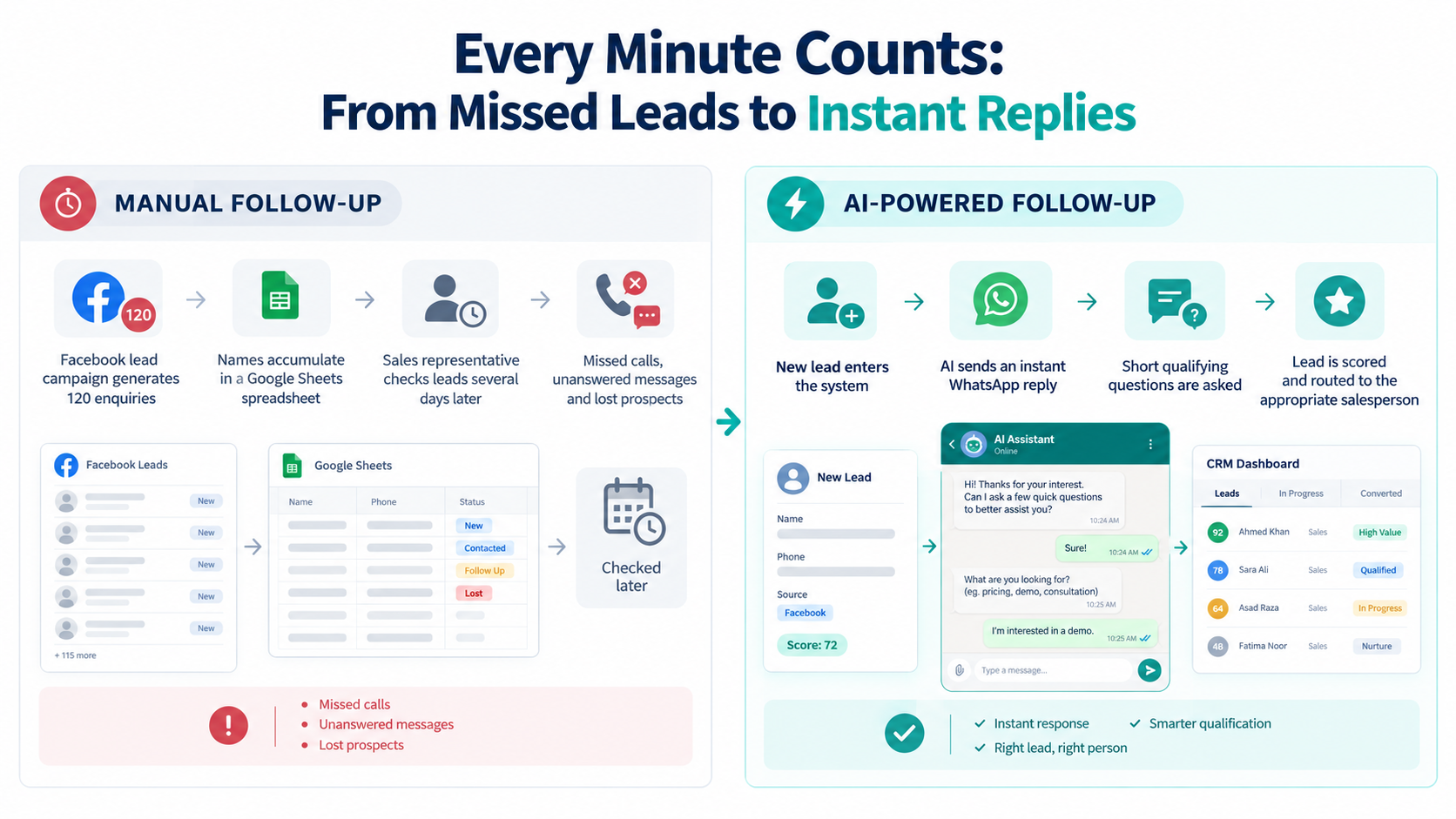
You spent Rs 40,000 on a Facebook lead campaign. By Monday there are 120 names in a Google Sheet. Your sales person starts calling on Thursday. Forty don't pick up. Thirty say "abhi zaroorat nahi". A dozen say they've already booked with someone else, the one who replied on Saturday night.
The leads weren't bad. They were late. That's the gap AI lead qualification closes: every enquiry gets a reply within minutes, the right questions get asked straight away, and follow-up keeps going until the lead answers or clearly says no.
This guide covers why leads go cold, which questions AI should ask in your industry, how scoring and follow-up work, when to stop, and when a person has to step in. It's part of our wider guide to AI automation for businesses in Pakistan.
Why do leads go cold so fast?
Leads go cold because interest fades within hours while most businesses take a day or more to reply. A Harvard Business Review study of 1.25 million leads found firms that reached out within an hour were nearly seven times more likely to qualify the lead than firms that waited just one hour longer.
The same research, by Oldroyd, McElheran and Elkington, found the odds were more than 60 times higher than for firms that waited 24 hours or more (Harvard Business Review, 2011). Their audit of 2,241 US companies showed only 37% replied within an hour, and 23% never replied at all.
That study is from 2011, but if anything the window has shrunk. Today a lead who fills your form also messages two competitors on WhatsApp in the same five minutes.
In Pakistan the delay usually comes from a handful of very ordinary causes:
- Leads sit in a sheet. Meta lead forms export to a Google Sheet that someone checks once a day, if that.
- Ads run all night, the team doesn't. Meta keeps delivering leads late at night, and every one of them waits until morning.
- Sales people are on calls or site visits. New leads pile up while they deal with the current ones.
- Follow-up stops after attempt two. Not because the lead said no, but because nobody remembered to chase.
- WhatsApp chats live on one person's phone. When that person is off, the leads are invisible to everyone else.
- Missed calls never get called back. If your leads mostly phone, AI voice agents that pick up missed calls close that gap too.
None of these is a people problem. They're a system problem, and that's exactly where automation helps.
What is AI lead qualification?
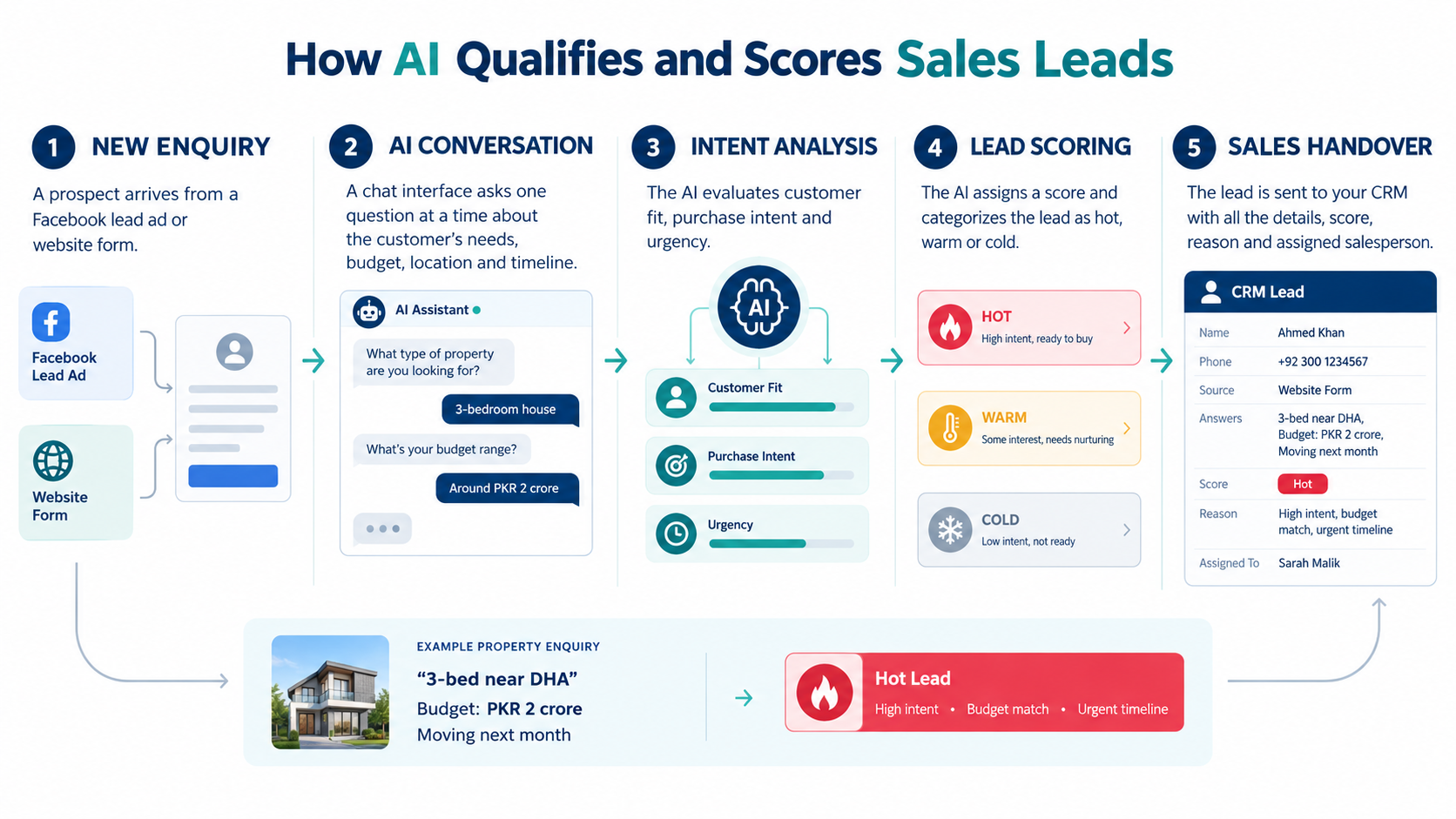
AI lead qualification is software that replies to a new enquiry instantly, asks a few qualifying questions in a natural conversation, reads the answers for budget, timing and intent, scores the lead, and passes the serious ones to the right sales person with everything already collected.
It's different from a lead form with a dropdown. A form asks everyone the same fixed questions and treats every answer the same way. AI reads what people actually write.
Compare two replies to the same property ad:
- "Bas price bata dein"
- "Next month shift ho rahe hain, 3 bed chahiye DHA ke paas, budget 2 crore tak"
A rule-based form logs both as "new lead". AI sees the second one has a timeline, a size, a location and a budget, and flags it as hot within seconds. The first one gets the price and a gentle follow-up question.
This is the core of what we build in sales and lead generation automation: instant replies, smart qualification and follow-up that doesn't depend on someone remembering.
What questions should AI ask to qualify a lead?
AI should ask three or four short questions, one at a time, covering what the lead needs, when they need it, their budget range and where they are. Anything longer feels like a form and people stop replying. The exact questions depend on your industry.
|
Industry |
Questions AI asks |
Signals a hot lead |
Signals a cold lead |
|---|---|---|---|
|
Real estate |
Buying or renting? Which area? Budget range? When do you plan to move? |
Specific area, budget stated, moving within 1 to 3 months |
"Bas rates dekh rahe hain", no budget, no timeline |
|
Education / admissions |
Which programme? Current qualification? Which intake? Day or evening classes? |
Eligible, names an intake, asks about fee instalments |
Wrong qualification, "next year sochein ge" |
|
Solar |
Home or business? Monthly bill roughly? Own the roof? City? |
High bill, owns the property, asks about net metering |
Renting, very small load, only wants a price list |
|
Clinics |
Which treatment? New or existing patient? Preferred day? |
Wants an appointment this week, specific treatment |
General price question only |
|
B2B services |
What are you trying to solve? Company size? Current tool or process? Decision timeline? |
Clear problem, decision this quarter, talks about the team |
Student, job seeker, "just exploring" |
A few rules make this work in practice:
- Answer their question first. If someone asks the price, give it (or a range), then ask your question. Qualification that dodges the customer's question feels like a trap.
- One question per message. Four questions in one block gets a reply to the first and silence on the rest.
- Match their language. If the lead writes in Roman Urdu, the AI replies in Roman Urdu. If they switch to English, it switches too.
- Don't ask what you already know. A Meta lead form already captured the name, number and city. Asking again tells the lead nobody read their form.
Hot, warm or cold: how AI lead scoring works
AI lead scoring combines three things: how well the lead fits your ideal customer, how strong their intent is from what they wrote, and how urgent their timeline is. The result is a hot, warm or cold label, with the reason written on the record so your sales person can see why.
|
Score |
What it usually means |
What happens next |
|---|---|---|
|
Hot |
Fits your customer profile, clear need, near-term timeline |
Alert to a sales person immediately, call within minutes |
|
Warm |
Fits, but the timeline is vague or a detail is missing |
Automated follow-up sequence, re-scored when they reply |
|
Cold |
Poor fit or no real intent |
One polite reply, light nurture or none |
The written reason matters more than the label. "Hot: 3-bed in DHA, 2 crore budget, moving next month" tells your agent exactly how to open the call. A bare number like "82/100" doesn't.
Scores should also fade over time. A hot lead from three weeks ago that never replied isn't hot anymore. And your first scoring rules will be wrong somewhere, which is normal. Compare the scores against the deals you actually closed after a few weeks and adjust.
We built exactly this into AI that scores and routes incoming leads for a 20-person agency: each new lead arrives with a score, a short summary of intent and a suggested owner.
AI lead follow-up automation: a cadence that works
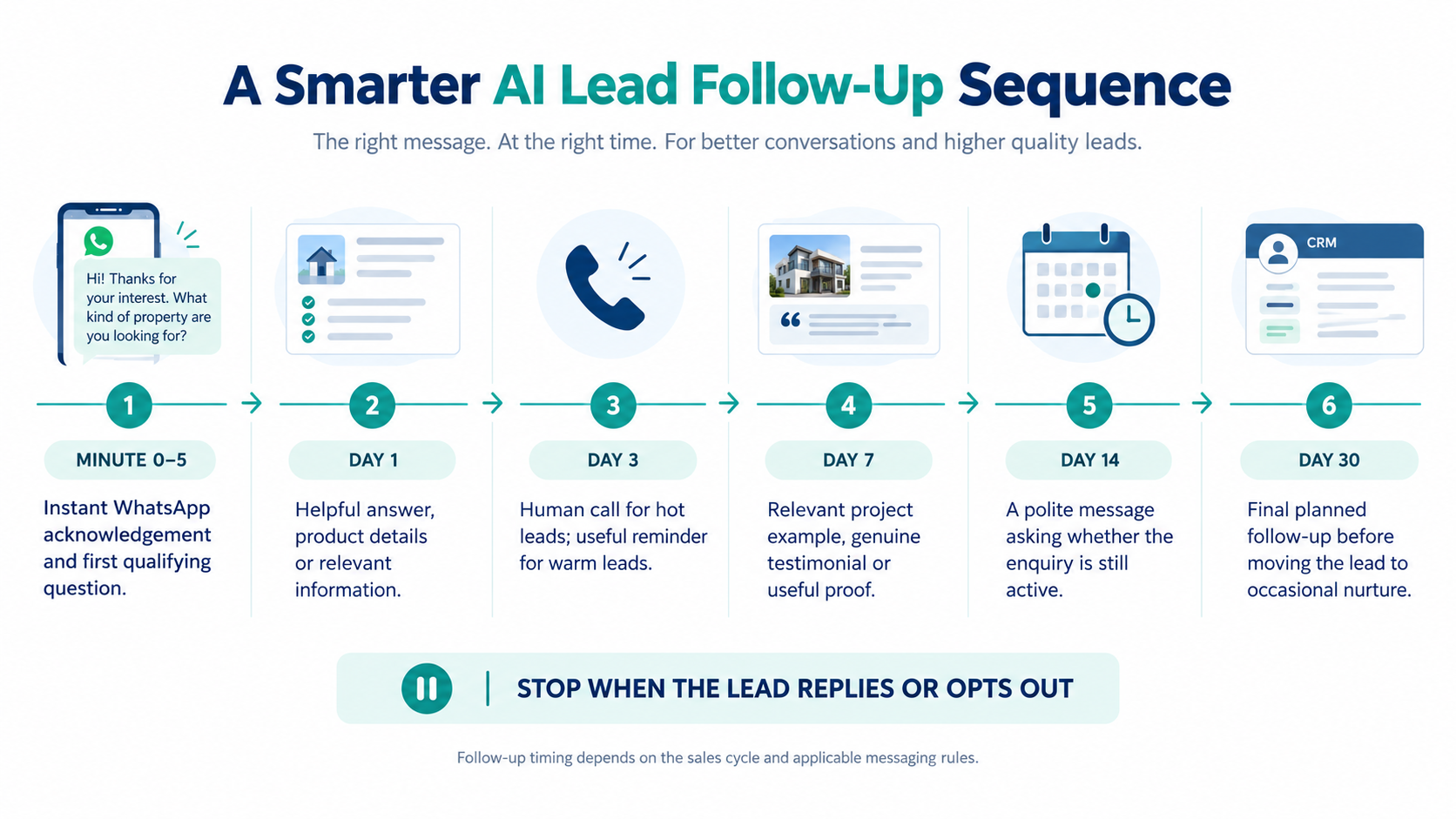
A good AI lead follow-up automation sends around five to seven useful touches over two to four weeks, mostly on WhatsApp, and stops the moment the lead replies. Each message should add something new, such as an answer, a photo, a date or an offer, rather than just "any update?"
Here's a starting cadence for a warm lead. Adjust the days to your sales cycle: a clinic needs a shorter one, real estate and B2B a longer one.
|
When |
Channel |
What it does |
|---|---|---|
|
Minute 0 to 5 |
|
Thanks them, answers their question, asks the first qualifying question |
|
Day 1 |
|
Follows up on the unanswered question, shares one useful detail (photos, fee structure, sample quote) |
|
Day 3 |
Call by a person (hot) or WhatsApp (warm) |
Hot leads get a human call; warm leads get a short reminder with a reason to reply |
|
Day 7 |
|
Social proof: a project, a testimonial, or a slot that's filling up (only if true) |
|
Day 14 |
WhatsApp or email |
"Should I keep this open for you?" A soft check that often gets the most honest replies |
|
Day 30 |
|
Last touch: new offer, new batch, new listing. Then move them to occasional nurture |
One WhatsApp rule shapes all of this. Once a lead has been quiet for more than 24 hours, a business can only message them using pre-approved message templates, and templates need Meta's approval before you can send them (Meta WhatsApp Business Platform docs). So write your day 1, 3, 7, 14 and 30 messages as templates in advance. Our guide covers WhatsApp template and messaging rules in more detail.
And the most important rule of all: the sequence stops the second they reply. From that point, it's a conversation, not a campaign.
When does follow-up become spam?
Follow-up becomes spam when it keeps going after the lead has answered, said no, bought, or gone quiet for weeks, or when messages arrive at the wrong time. Clear stop rules prevent this, and they protect your WhatsApp number's quality rating as well as your reputation.
Set these stop rules before launch:
- They replied. The sequence pauses and a person or the AI picks up the conversation.
- They said no. "Nahi chahiye", "not interested", "remove kar dein", "mat bhejein". AI can detect these in any language and mark the lead closed.
- They bought. Sounds obvious, but if your CRM isn't updated, the follow-up keeps selling to an existing customer.
- They blocked or reported. Stop immediately and review what went wrong.
- Maximum touches reached. After the last message in the cadence, move them to occasional updates only.
Two more habits keep follow-up respectful. Keep automated messages to normal hours, roughly 9 a.m. to 9 p.m., unless the lead messaged you first. And never invent urgency ("only 2 plots left") when it isn't true. Pakistani buyers have seen every trick, and a fake deadline costs you the lead for good.
Where does a person need to take over?
A person should take over as soon as a lead is hot, wants to negotiate, asks for a visit or meeting, raises a complaint, or is a big-ticket deal where trust decides the sale. AI handles speed and consistency. People close.
The handover should come with context. Your sales person gets the lead's answers, the score with its reason and the full chat, so the first call starts with "You're looking for a 3-bed near DHA, moving next month, right?" instead of "Haan ji, kya chahiye tha?"
This is the same handover logic we use for support chats. Our guide on AI customer support automation in Pakistan covers how to design the handover so customers never repeat themselves.
Your CRM is the backbone
AI lead qualification only works if every lead, answer, score and message lands in one place your whole team can see. That place is a CRM. Without it, scores sit in a chat window, duplicate leads get called twice, and nobody knows which ad actually produced the sale.
A spreadsheet is fine for a small pilot with one sales person and one lead source. Once you have several people working the same leads, or leads coming from Meta, WhatsApp, your website and Google Ads at once, those are clear signs you have outgrown your lead spreadsheet.
Whatever CRM you choose, make sure it does four things for lead automation:
- Removes duplicates so the same person from a form and a WhatsApp chat becomes one record
- Records the source of every lead, so you can see cost per qualified lead by campaign
- Keeps the full history: AI answers, score reasons, messages and calls on one timeline
- Assigns an owner with a task and a reminder, so hot leads never sit unclaimed
If you're still deciding, our guide on choosing a CRM for a small Pakistani business covers what to look for. And if your sales process doesn't fit a standard tool, we build CRM and ERP systems built around your sales process.
How do you measure whether it's working?
Track five numbers before and after launch: first response time, contact rate, qualification rate, meetings or visits booked, and cost per qualified lead. The last one matters most, because it ties your automation directly to your ad spend.
|
Metric |
What it tells you |
What to watch for |
|---|---|---|
|
First response time |
How long a new lead waits for any reply |
Should drop from hours to minutes, including nights and weekends |
|
Contact rate |
Share of leads who reply or answer at least once |
If it doesn't rise, your first message needs work |
|
Qualification rate |
Share of leads scored hot or warm |
A sudden jump can mean your scoring is too generous |
|
Meetings / visits booked |
Leads who reach a real sales conversation |
The number your sales team actually feels |
|
Cost per qualified lead |
Ad spend divided by qualified leads |
Compare by campaign to see which ads bring buyers, not just names |
Take two weeks of baseline numbers before you switch anything on. Without the "before", nobody can prove the "after".
The gains are real when the basics are in place. On one of our builds, a sales platform that built SAR 600,000 of pipeline in one month, the sales team, outbound and records all ran from one system instead of scattered sheets and inboxes.
A 5-step rollout for your lead pipeline
Start with one lead source and one set of questions, run it with a person checking the AI's replies, then expand. Trying to automate every channel and every product in week one is the most common reason these projects stall.
- Pick your biggest lead source. For most Pakistani businesses that's a Meta lead form or a click-to-WhatsApp ad.
- Write your qualifying questions. Three or four, based on what your best sales person asks first. Use the industry table above as a starting point.
- Connect the source to your CRM. Tools like n8n workflows that connect your lead sources move each lead into your CRM the moment it arrives, deduplicated and tagged.
- Run with human review for two weeks. The AI drafts replies and scores; a person approves. Fix the questions and scoring rules wherever it gets things wrong.
- Switch on full automation and add follow-up. Let the AI reply and run the cadence on its own, with hot leads alerting a person instantly. Then add your next lead source.
If you're deciding between an off-the-shelf tool and a custom build, the same custom vs ready-made CRM trade-offs apply: start with ready-made if it fits, build only where it doesn't. Cost mostly depends on lead volume, the number of channels and how many systems need connecting.
FAQs
How fast should you reply to a new lead?
Reply within minutes if you can, and within an hour at the most. A Harvard Business Review study found firms that reached out within an hour were nearly seven times more likely to qualify a lead than those that waited one hour longer.
Can AI qualify leads on WhatsApp?
Yes, AI can qualify leads on WhatsApp by asking three or four questions in the chat, reading the answers and scoring the lead. You need the official WhatsApp Business Platform and approved message templates for any follow-up sent after the 24-hour window.
How many times should you follow up a lead?
A good starting point is five to seven useful follow-ups over two to four weeks, stopping as soon as the lead replies or says no. Shorten it for quick decisions like clinic bookings and lengthen it for property or B2B sales.
Will automated follow-up annoy my customers?
Automated follow-up only annoys customers when it ignores their replies, keeps going after a no, or arrives late at night. With clear stop rules, normal sending hours and messages that add something new each time, most leads see it as good service.
Can AI follow up with leads in Urdu?
Yes, AI can reply and follow up in Urdu, Roman Urdu or English, matching whatever language the lead used. Test it on a few hundred of your real past chats first, because spelling and slang vary a lot between industries and cities.
Do I need a CRM to automate lead follow-up?
You can pilot lead automation with a Google Sheet, but you need a CRM once more than one sales person or more than one lead source is involved. Without a CRM you lose duplicate checks, lead ownership and a clear view of which campaigns bring buyers.
Does AI replace my sales team?
No, AI replaces the waiting and the chasing, not the selling. It replies instantly, asks the first questions and keeps following up, while your sales people handle calls, visits, negotiation and closing.
The lead you paid for today is worth the most in the next hour
Most businesses try to fix weak sales by buying more leads. Usually the better fix is to stop losing the ones you already paid for.
AI lead qualification and follow-up won't make a bad offer sell. What it does is make sure every enquiry gets a fast reply, the right questions, steady follow-up and a quick handover to a person when it matters. Start with your biggest lead source, keep the questions short, set clear stop rules, and measure cost per qualified lead from day one.
If you want to see where your pipeline is leaking, get a free pipeline audit from the Lumen AI team. We'll map your lead sources, response times and follow-up, and tell you honestly whether automation is worth it for your business.