AI Automation for Online Stores in Pakistan: From Order Placed to Cash Collected
17 min read

On this page
- Where Pakistani online stores lose money: the COD funnel
- What is AI automation for an online store?
- Stage 1: confirm every COD order before you ship it
- Stage 2: score order risk instead of treating every order the same
- Stage 3: nudge customers toward prepaid without losing the sale
- Stage 4: ship, track and answer "order kahan hai?" automatically
- Stage 5: reconcile COD so your losses stop being invisible
- Ecommerce automation in Pakistan when you sell on Shopify and Daraz
- Is a Shopify app enough, or do you need custom automation?
- What to automate first: a 5-step rollout
- FAQs
- How can I reduce COD returns in Pakistan?
- Can AI detect fake COD orders?
- How do I confirm COD orders automatically?
- Can Shopify and Daraz share the same stock?
- Is a Shopify app enough for a Pakistani online store?
- How do I reconcile courier COD payments?
- What should a small online store automate first?
- Measure cash collected, not orders placed
Monday morning, your Shopify dashboard shows 100 new orders from the weekend. Good weekend. By the end of the month, the courier has paid you for about half of them.
The rest didn't vanish in one place. Some customers never answered the confirmation call. Some said "haan bhej do" and then weren't home. A few gave an address that just said "near masjid". And a handful of parcels are still somewhere between Karachi and Quetta, waiting to come back.
That gap between order placed and cash collected is where AI automation for online stores in Pakistan actually pays off. Not in fancy product recommendations, but in confirming orders, spotting risky ones, answering "order kahan hai?" and making sure every rupee the courier owes you is accounted for. This guide walks through each stage, what rules can handle on their own, and where AI genuinely helps. It's part of our wider guide to AI automation for businesses in Pakistan.
Where Pakistani online stores lose money: the COD funnel
Pakistani online stores lose most of their money between the order and the cash, not at checkout. In a 2026 study of about 170,000 orders from one large Pakistani retailer, only about 49 of every 100 cash-on-delivery orders ended with cash collected. The rest were cancelled before shipping or came back undelivered.
The study, published by OrderNation Research in June 2026, is the most detailed public data on Pakistani COD behaviour so far. Here's what it found:
- Cash on delivery was 94.5% of orders. Prepaid was just 1.6%.
- COD orders were cancelled 37.3% of the time, against 2.8% for prepaid. That's more than 13 times higher, and the gap held in every single month.
- About 1 in 5 shipped COD parcels came back to the seller. This return-to-origin (RTO) rate sat between 19% and 22% every month, so it isn't seasonal.
- Roughly three-quarters of cancellations happened before dispatch, at the confirmation stage.
Put those together and the funnel looks like this: 100 COD orders placed, about 63 survive and ship, and about 49 end with cash in hand. The study itself puts the honest range at 49 to 57.
Two caveats are worth knowing. This is one retailer selling mostly mobile accessories, so it's a benchmark, not a national census. And other sources land in a similar place: DHL Pakistan also puts the typical COD return rate at roughly 1 in 5 parcels. You'll see much scarier numbers online, like 40% or 60% RTO, but most of them come from app sellers with no method behind them.
The most useful finding is the one most people skip: most of the loss happens before the parcel leaves your warehouse. That's good news, because it's the cheapest stage to fix.
What is AI automation for an online store?
AI automation for an online store is software that handles the repetitive work between checkout and cash collection, such as confirming orders, checking addresses, booking couriers, answering order-status questions and reconciling payments, and uses AI for the parts that involve reading messy human input.
That last part matters, because a lot of what gets sold as "AI" in e-commerce is really just rules. Rules are fine. They're cheaper and more predictable. The trick is knowing where each one belongs.
|
Task |
Plain rules handle it |
AI adds real value |
|---|---|---|
|
Booking a courier and printing labels |
Yes |
No |
|
Syncing stock between Shopify and Daraz |
Yes |
No |
|
Sending tracking updates |
Yes |
No |
|
Flagging a phone number with past refusals |
Yes |
No |
|
Reading a confirmation reply like "kal subah 11 baje ke baad bhejna" |
No |
Yes |
|
Cleaning up an address like "gali no 4 wala ghar, bakery ke saath" |
Partly |
Yes |
|
Answering "order kahan hai?" in a chat |
Partly |
Yes |
|
Spotting which orders look risky from several weak signals |
Partly |
Yes |
|
Summarising why customers are returning a product |
No |
Yes |
The pattern is simple: rules for anything structured, AI for anything a person writes or says. At Lumen AI, this is how we build the automation that sits behind your store: rules do the routine work, AI handles the messy input, and a person only sees what genuinely needs a decision.
Stage 1: confirm every COD order before you ship it
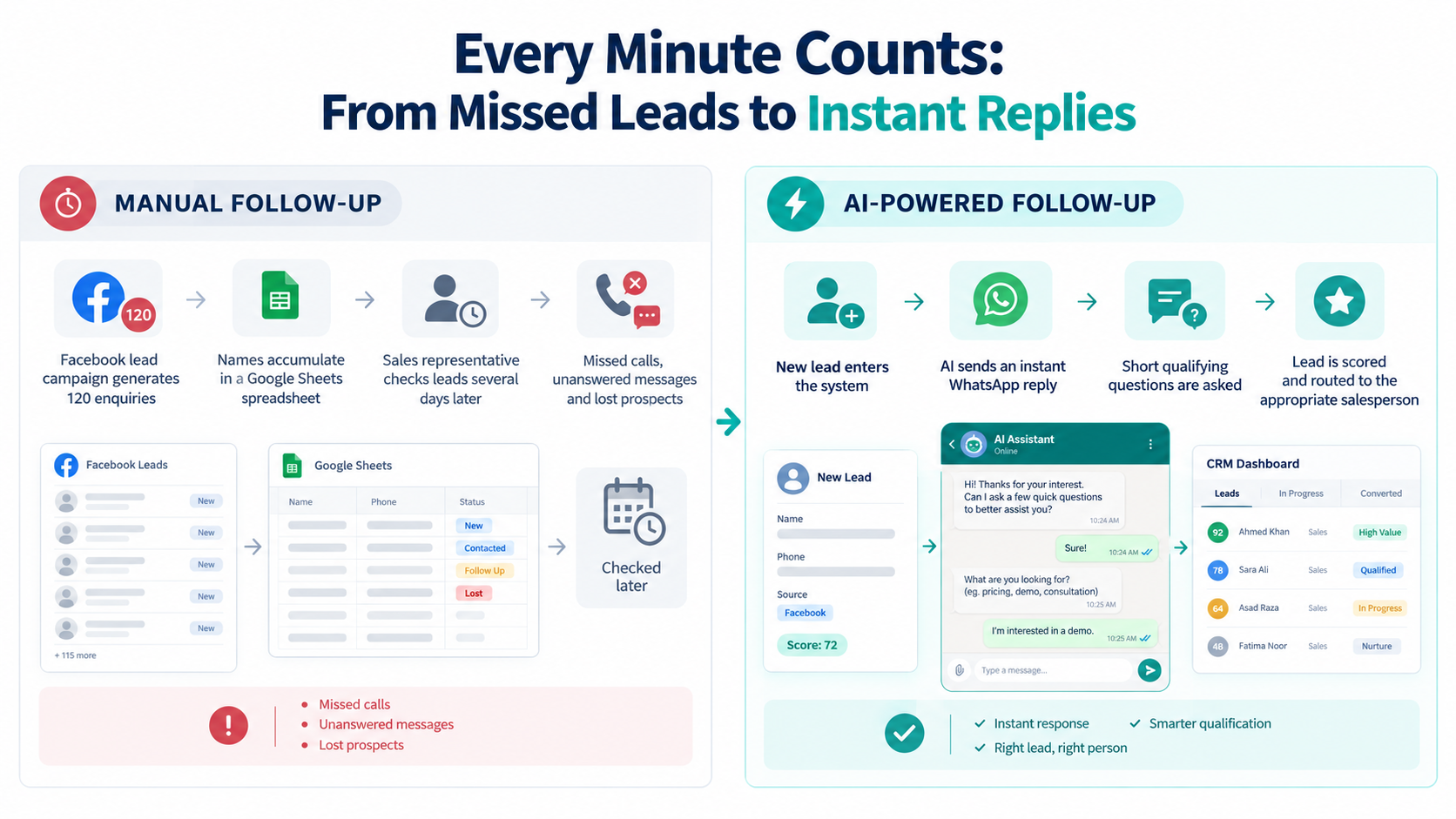
Order confirmation is the first thing to automate because most COD failure happens before dispatch. An automated flow messages the customer on WhatsApp within minutes of checkout, reads their reply, fixes the address if needed, and only releases the order to the courier once it's confirmed.
Most Pakistani stores already confirm orders. The problem is that it's done by a person with a phone and a spreadsheet, so it's slow, it stops at 6 p.m., and it falls apart on sale days when 400 orders arrive at once.
Here's what an automated confirmation flow does:
- Sends a WhatsApp message right after checkout with the order summary, total amount and delivery address, plus two clear buttons: confirm or cancel.
- Reads whatever the customer actually writes. Buttons cover most replies, but plenty of customers type instead. AI reads "haan bhej do", "thora late bhejna, Eid ke baad", "size L kar dein" or "maine order nahi kiya" and turns each into the right action: confirm, delay, edit or cancel.
- Fixes the address while the customer is still engaged. If the address is vague, the message asks for a landmark or a pin location before the parcel leaves.
- Follows up on silence. No reply in a few hours gets one reminder. Still nothing, and the order goes to a call.
- Updates the order automatically. Confirmed orders move to dispatch, cancelled ones never ship, and edits land on the order without anyone retyping them.
WhatsApp has rules about which messages a business can send and when, including pre-approved templates for messages outside the 24-hour reply window. Our guide covers the WhatsApp Business Platform rules and template messages in detail, so plan your confirmation templates before you build anything.
For customers who don't read WhatsApp, a phone call still works best. That call no longer has to be a person, either. AI voice agents that call customers who don't reply can confirm in Urdu, note any address change and hand off to your team when the customer has a question.
Stage 2: score order risk instead of treating every order the same
Not every COD order deserves the same checks. Scoring each order by risk lets you ship the safe ones straight away and spend confirmation effort, calls and advance payments only on the orders most likely to come back.
The OrderNation study found that where an order came from made a big difference. Orders from people who searched for the product came back 14.2% of the time. Orders from social media ads came back 22.7% of the time, roughly 1.6 times as often. Impulse buyers who tapped an ad in their feed are simply less committed than people who went looking.
That's the case for risk scoring. Treating every order with maximum suspicion annoys your best customers. Treating every order as safe ships parcels that come straight back.
Useful risk signals for a Pakistani store include:
- Traffic source: search, social ad, WhatsApp, repeat customer
- Customer history: past refusals or unreachable deliveries on the same phone number
- Delivery area: cities and areas where your parcels often fail
- Order details: unusually high value, mismatched name and address, multiple orders in minutes
- Confirmation behaviour: no reply, vague reply, wrong number
|
Risk level |
Typical signals |
Action |
|---|---|---|
|
Low |
Repeat customer, search traffic, good delivery area |
Ship after automatic WhatsApp confirmation |
|
Medium |
First order from a social ad, or one weak signal |
Confirm on WhatsApp and call if there's no reply |
|
High |
Past refusals, unreachable number, or several weak signals together |
Ask for a small advance or full prepayment before shipping |
Rules can handle the obvious signals, like a blacklisted phone number. AI helps when several weak signals add up, or when the confirmation reply itself sounds unsure. It's the same scoring logic we use for sales leads, and our guide to AI lead qualification and follow-up explains how to tune scores against real outcomes.
One honest point: AI can flag risk, but it can't prove someone is a fake buyer. Keep a person in the loop for high-value orders and anything you'd be embarrassed to cancel by mistake.
Stage 3: nudge customers toward prepaid without losing the sale
The biggest single lever on COD losses is getting more customers to pay upfront. A small, well-timed prepaid offer inside the confirmation chat, such as free delivery for paying through JazzCash or Easypaisa, moves some buyers to prepaid without forcing anyone who isn't ready.
The OrderNation numbers explain why this matters so much: COD orders were cancelled 37.3% of the time and prepaid orders just 2.8%. But be careful how you read that. The study itself points out that people who prepay were already more committed, so switching a buyer to prepaid won't cut their cancellation risk 13 times. It will still help.
A few practical rules:
- Offer it, don't force it. Removing COD entirely loses far more sales than it saves for most Pakistani stores.
- Make it worth something. Free delivery or a small discount works better than a vague "pay online".
- Use it as your high-risk tool. For orders scored high risk, a partial advance (for example, the delivery charge) is a fair middle ground.
- Make paying easy. A payment link in the same WhatsApp chat converts better than sending people back to the website.
Stage 4: ship, track and answer "order kahan hai?" automatically
Once an order is confirmed, rules can handle the shipping side on their own: book the courier, print the label, push the tracking number to the customer and update the order. AI comes in on the customer side, answering "where is my order" chats with live tracking data instead of a copy-paste reply.
The shipping part is the most mature piece of e-commerce automation in Pakistan. Plenty of Shopify and WooCommerce apps already book TCS, Leopards, PostEx, Trax, M&P and other couriers in bulk and sync tracking back to the store. If you're still copying tracking numbers by hand, this is the quickest win you'll get.
Where stores still struggle is the flood of status questions that follows. "Order kahan hai?" "Kab tak aayega?" "Rider ne call nahi kiya." Each one takes a person a minute or two to look up, and on a busy week there are hundreds. Two things fix this:
- Proactive updates. Message the customer when the parcel ships, when it's out for delivery, and especially when it's delayed. Many of those questions never get asked.
- An AI agent that checks the live status. When someone does ask, the agent looks up the order and the courier's tracking, and replies with the actual answer in the customer's language.
Our guide to AI support for "where is my order" chats covers this setup, including when a chat should go to a person. The core of it is support agents that look up live order status rather than reciting a generic delivery policy.
One small touch that helps delivery: a message on the morning of delivery ("Aaj aapka parcel aa raha hai, Rs 3,450 cash ready rakhein") cuts down on "customer not available" and "no change" failures at the door.
Stage 5: reconcile COD so your losses stop being invisible
COD reconciliation means matching every courier payment against the orders it covers, and tracking every parcel that came back. It matters because failed COD deliveries don't show up as refunds in Shopify or WooCommerce, so without reconciliation the loss simply never appears on your dashboard.
The OrderNation study makes this point sharply. Across about 13,800 orders in one month, refunds in the store dashboard added up to almost nothing, while one in five shipped parcels was coming back. A failed delivery also took a median of 21.7 days to show up in the seller's books. If you only look at your store analytics, you're looking at a business that's doing much better than yours actually is.
Automated reconciliation does three jobs:
- Matches remittances to orders. Every line in a courier payment is matched to an order, and short payments are flagged straight away.
- Closes the loop on returns. Every RTO parcel is tracked until it's back in stock or written off.
- Reports delivery success by city and courier. So you can see where parcels actually fail.
That last one often surprises people. In the OrderNation data, the choice of courier made no statistically significant difference in 43 of 50 cities. Delivery success was driven far more by where the customer lived than by who carried the parcel. So before you switch couriers, check whether the problem is really the courier or the area.
We've written a detailed guide on how ERP handles COD reconciliation and RTO, including what to do with returned stock, so we won't repeat it here.
Ecommerce automation in Pakistan when you sell on Shopify and Daraz
If you sell on both your own store and Daraz, the most important automation is a single stock number that both channels draw from. Without it, the last unit sells on Daraz while your Shopify store still shows it in stock, and someone spends the afternoon cancelling and apologising.
Multi-channel selling brings a few specific jobs:
- One stock ledger that updates every channel after each sale, with a small buffer on Daraz because marketplace updates aren't always instant
- One order queue so Daraz and website orders go through the same packing and dispatch process
- One product record that's reformatted for each channel instead of typed in twice
Most of this is rules, not AI. Tools like n8n workflows connecting your store, couriers and sheets handle it well for smaller stores. Once stock, accounting and several warehouses are involved, a proper inventory system makes more sense. We built an ERP that handled about $300k of monthly stock movement, bringing stock, sales, purchasing, POS and accounting into one system so every channel reads the same numbers.
Is a Shopify app enough, or do you need custom automation?
For a single store with one or two couriers and a few hundred orders a month, a Pakistani Shopify or WooCommerce app is usually enough. Custom automation starts to make sense when you sell on several channels, need stock and accounting to stay in sync, or want risk rules and reports built around your own data.
There's no shame in starting with an app. Several local apps already handle courier booking, tracking, COD reconciliation and WhatsApp confirmation, and some now add automated calls to customers who don't reply. Install one, measure your numbers for a month, and only build when you hit its limits.
|
An app is usually enough if... |
Custom automation makes sense if... |
|---|---|
|
You sell on one storefront |
You sell on Shopify, Daraz and other channels together |
|
You use one or two couriers |
You split orders across several couriers by city |
|
A standard confirmation message works for you |
You want risk scoring based on your own order history |
|
Courier reports cover your reconciliation |
You need COD, returns and fees flowing into accounting |
|
Orders are in the hundreds per month |
Orders are in the thousands, or peak sales break your process |
|
One person can oversee everything |
Several teams touch an order before it ships |
Two signs you've outgrown the app-and-spreadsheet setup: you have several versions of the same sheet floating around WhatsApp, and month-end means one person spending days matching courier payments by hand. Our guide to the signs your store has outgrown spreadsheets goes through the rest.
When you do go custom, the goal is to connect your CRM and ERP with your store and couriers, so customer history, orders, stock and money all live in one set of records instead of four.
What to automate first: a 5-step rollout
Start by measuring your real numbers, then automate order confirmation, because that's where most COD orders are lost. Add risk scoring, tracking updates and reconciliation one at a time, checking the numbers after each step so you know what actually worked.
- Measure your baseline for two to four weeks. Track three numbers: COD cancellation rate, RTO rate (returned parcels divided by shipped parcels) and cash collected per 100 orders placed. Without these, you can't tell whether anything helped.
- Automate order confirmation. WhatsApp message at checkout, AI reading replies, address cleanup, a call for non-responders. Hold every order until it's confirmed.
- Add simple risk rules. Start with the obvious ones: repeat refusers, unreachable numbers, weak delivery areas, first orders from social ads. Ask high-risk orders for a small advance.
- Automate tracking updates and "order kahan hai?" replies. Proactive messages first, then an AI agent for the questions that still come in.
- Automate reconciliation and reporting. Match courier payments to orders, track every return, and report delivery success by city and courier. Then review your risk rules against what actually came back.
Repeat the measurement after each step. Some stores find confirmation alone fixes most of the problem. Others discover their real issue is two or three cities where nothing gets delivered.
FAQs
How can I reduce COD returns in Pakistan?
Confirm every COD order before dispatch, focus extra checks on risky orders, offer a small reward for prepaying, and track returns by city and courier. Roughly 1 in 5 shipped COD parcels comes back in Pakistan, so measure your own rate against that benchmark first.
Can AI detect fake COD orders?
AI can flag orders that look risky, such as repeat refusers, unreachable numbers, vague addresses or impulse orders from social ads, but it can't prove a buyer is fake. Use the risk score to decide who gets a call or an advance request, and keep a person involved for high-value orders.
How do I confirm COD orders automatically?
Send a WhatsApp message with the order details right after checkout, let AI read the customer's reply in Urdu, Roman Urdu or English, and call anyone who doesn't respond. Confirmed orders go to dispatch automatically, and cancelled ones never ship.
Can Shopify and Daraz share the same stock?
Yes, Shopify and Daraz can share one stock number through an inventory sync that updates both channels after every sale. Keep a small stock buffer on Daraz, because marketplace updates aren't always instant and overselling the last unit is the most common problem.
Is a Shopify app enough for a Pakistani online store?
A Pakistani Shopify app is usually enough for one store, one or two couriers and a few hundred orders a month. Once you sell on several channels or need stock, COD and accounting connected, custom automation starts to pay for itself.
How do I reconcile courier COD payments?
Match every line of a courier remittance to the order it belongs to, flag any short payments, and track each returned parcel until it's back in stock. Doing this automatically matters because failed COD deliveries don't appear as refunds in your store dashboard.
What should a small online store automate first?
A small online store should automate order confirmation first, because most COD orders are lost before they ship. Measure your cancellation and return rates for a few weeks before and after, so you can see what actually changed.
Measure cash collected, not orders placed
In most markets, an order is revenue. In Pakistan, an order is a promise that the customer can still turn down at the door. That one difference changes what's worth automating.
The stores that do well with AI automation aren't the ones with the cleverest chatbot. They're the ones that confirm every order before it ships, put extra effort only where the risk is, keep customers informed without being asked, and know exactly how much cash each courier owes them. Start with confirmation, measure what changes, and add the next stage only when the numbers tell you to.
If you want a clear picture of where your orders are leaking, get a free commerce ops review from the Lumen AI team. We'll look at your confirmation process, return rates, couriers and reconciliation, and tell you honestly whether an app will do or whether custom automation is worth it.