
AI Customer Support Automation in Pakistan: What to Automate and What to Keep Human
15 min read

On this page
- What is AI customer support automation?
- Big Pakistani brands already do this. Here's the small business version
- Which customer support tasks can AI automate?
- Which support channel should you automate first?
- Handling Roman Urdu, mixed language and voice notes
- When should AI hand the conversation to a human?
- Start with agent assist, not a customer-facing bot
- How do you measure whether AI support is working?
- Ready-made support chatbot or custom AI workflow?
- A 5-step rollout for a small support team
- FAQs
- Will AI replace my customer support team?
- What is a good AI resolution rate for customer support?
- Can an AI support bot understand Roman Urdu?
- Do customers in Pakistan accept AI customer support?
- Can AI answer customer phone calls in Urdu?
- Is customer data safe with AI support tools?
- How long does it take to set up AI customer support?
- Start with the question your team answers 40 times a day
It's Monday, 9:15 in the morning. Your one support person opens the laptop to 63 unread messages: 38 on WhatsApp, 14 Instagram DMs, 11 emails. Most of them ask the same five things. "Order kab aayega?" "Exchange ho sakta hai?" "Refund kab milega?" By the time she reaches message 40, the customer from message 3 has already left a one-star review.
That's the problem AI customer support automation in Pakistan solves. Not by replacing your support team, but by taking the repetitive first layer off their plate so they can spend time on the customers who actually need a person.
This guide covers what AI can handle, which channel to start with, how to deal with Roman Urdu and voice notes, when the AI must hand over to a human, and how to tell whether it's working. It sits inside our wider guide to AI automation for Pakistani businesses, so if you want the bigger picture first, start there.
What is AI customer support automation?
AI customer support automation is software that reads incoming customer messages, works out what the customer needs, answers from your own policies and data, takes simple actions like checking an order, and passes anything complex to a human agent with a summary.
That's very different from the support automation most Pakistani businesses already know. A keyword bot sends your return policy whenever someone types "return". An IVR makes callers "press 1 for billing". Both break the moment a customer writes like a real person: "bhai jo shirt mangwai thi wo choti hai, change karwa dein, aur delivery charges dobara lagenge?"
An AI support agent can pull three things out of that one message: an exchange request, a size problem, and a question about delivery charges. Then it checks the order, answers the charges question from your policy, and starts the exchange.
The key part is where the answers come from. A well-built system uses a method called retrieval-augmented generation (RAG). In plain words, the AI looks up your own return policy, product details and order records before it replies, instead of guessing from the internet. That's what stops it from inventing a refund policy you don't have.
At Lumen AI, this is what our AI chatbots and support automation work is built around: answers grounded in your documents, live lookups in your systems, and a clean handover to your team.
Big Pakistani brands already do this. Here's the small business version
AI customer support is already live at some of Pakistan's biggest consumer brands, and it works in Urdu and Roman Urdu. What's changed in 2026 is that a business with three to ten support staff can now use the same approach without a telecom-sized budget.
A few examples you may have used yourself:
- Onic launched AI Assist in July 2026, an in-app chat that understands Roman Urdu, Urdu-English mixed messages and common spelling variations, and passes the chat to a human agent with the context intact (ProPakistani).
- easypaisa rolled out "ello", an AI chatbot inside its app, in February 2026.
- PTCL and Ufone run an Urdu-language AI customer service platform built on Urdu speech recognition and language models.
- UBL added voice commands in English and Urdu to its banking app in January 2026.
These companies have large in-house teams. You don't need one. The building blocks they use, a language model, your knowledge base, a connection to your order or CRM data, and a human inbox, are now available off the shelf or as a focused custom build. The difference is scope: you start with the 20 questions your team answers every day, not with every customer journey at once.
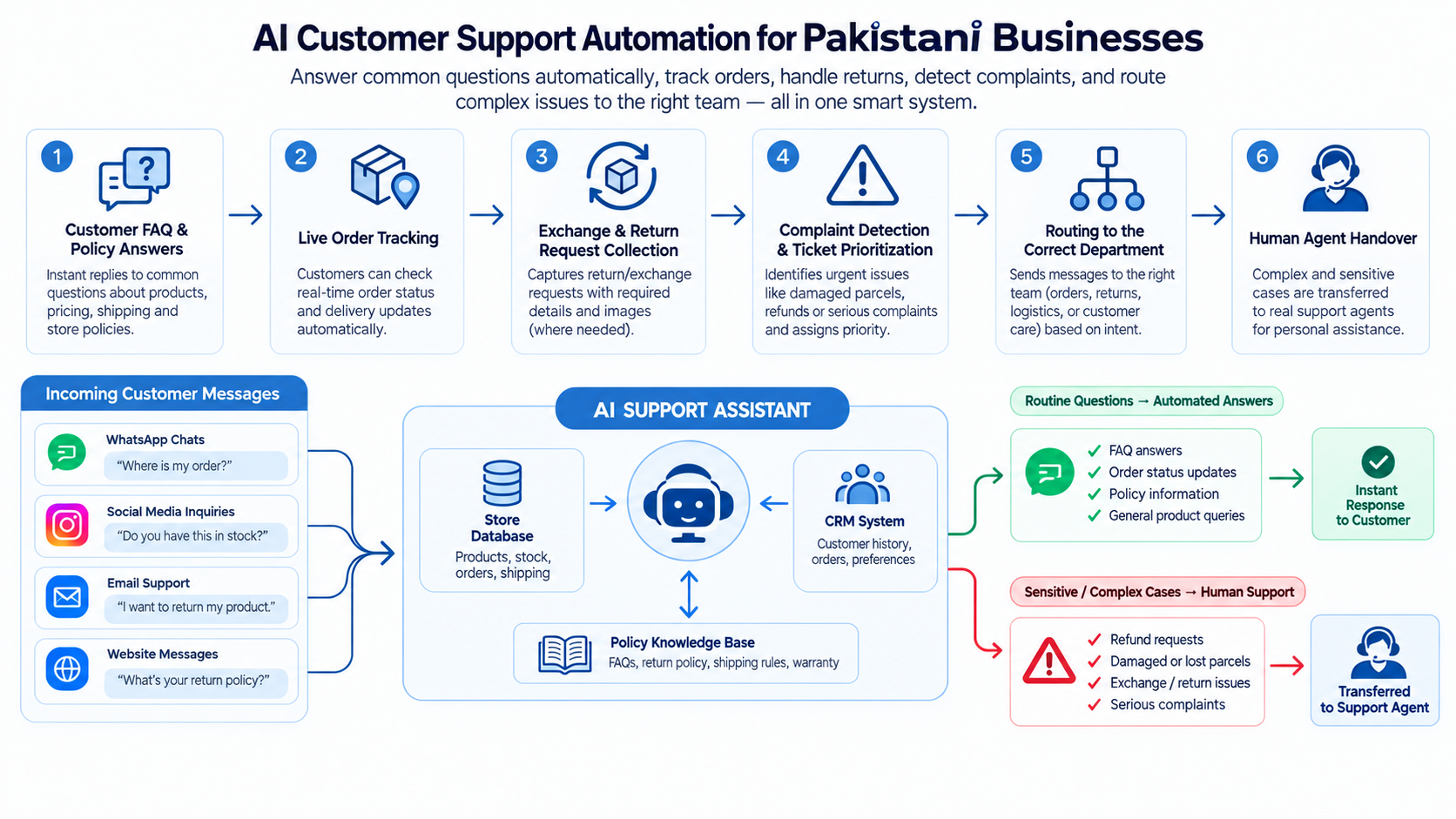
Which customer support tasks can AI automate?
AI is best at support tasks that repeat all day and follow a clear pattern: policy questions, order status, exchange requests, ticket sorting and after-hours replies. Anything involving money disputes, angry customers or a judgment call should still reach a person, with the AI doing the groundwork first.
|
Support task |
What AI handles |
What stays human |
|---|---|---|
|
Policy and FAQ questions |
Answers from your return, delivery and warranty policies |
Exceptions to the policy |
|
Order status |
Pulls the status from your store or courier and replies |
Lost or damaged parcels |
|
Exchange and return requests |
Collects order number, reason and photos, opens the request |
Approving refunds |
|
Complaint intake |
Records the issue, detects tone, tags urgency |
Resolving the complaint |
|
Ticket tagging and routing |
Sorts each message to billing, delivery, technical or sales |
Reassigning edge cases |
|
After-hours replies |
Answers at 2 a.m. and logs anything it can't solve for the morning |
Morning follow-up |
|
Appointment changes |
Offers new slots and confirms the change |
Double-booking conflicts |
|
Ticket summaries |
Turns a 30-message thread into three lines for the agent |
Reading and deciding |
|
Feedback after resolution |
Sends a short CSAT question and logs the score |
Responding to low scores |
For online stores, order status and exchanges usually make up the biggest share of support volume, and they need a live link to your store data. That's where support automation overlaps with order and returns automation for online stores on Shopify, WooCommerce and Daraz.
Notice the split in the table. The AI reads, sorts, looks things up and collects details. People decide. That division is what keeps automation helpful instead of irritating.
Which support channel should you automate first?
For most Pakistani businesses, WhatsApp is the right first channel because that's where the bulk of support messages land. Instagram DMs come next for fashion and beauty brands. Phone calls are the hardest to automate well, so they usually come last, after text channels are working.
|
Channel |
Typical share of support in a Pakistani SME |
How hard to automate |
Best first use |
|---|---|---|---|
|
|
Highest for most consumer businesses |
Medium (needs the official Business Platform) |
Order status, FAQs, exchange requests |
|
Instagram DMs |
High for fashion, beauty, food |
Medium |
Price, size and availability questions |
|
Website chat |
Low to medium |
Easy |
FAQs and lead capture |
|
|
Medium for B2B and services |
Easy |
Ticket tagging and draft replies |
|
Phone |
High for banks, telecom, clinics |
Hard |
Call routing, then simple lookups |
WhatsApp has its own rules on business numbers, message templates and costs. Rather than repeat them here, read our guide on how WhatsApp AI automation works before you choose a tool.
Phone support is a separate build. If your customers mostly call, look at AI voice agents that answer calls in Urdu and English, and start with routing callers to the right person before letting the AI resolve anything itself.
One point from recent research is worth keeping in mind. Gartner found customers are about three times more likely to use their own GenAI tools, like ChatGPT, than a company's chatbot for service issues (Gartner, July 2026). A generic chat widget on your website rarely gets used. Put the AI where your customers already talk to you.
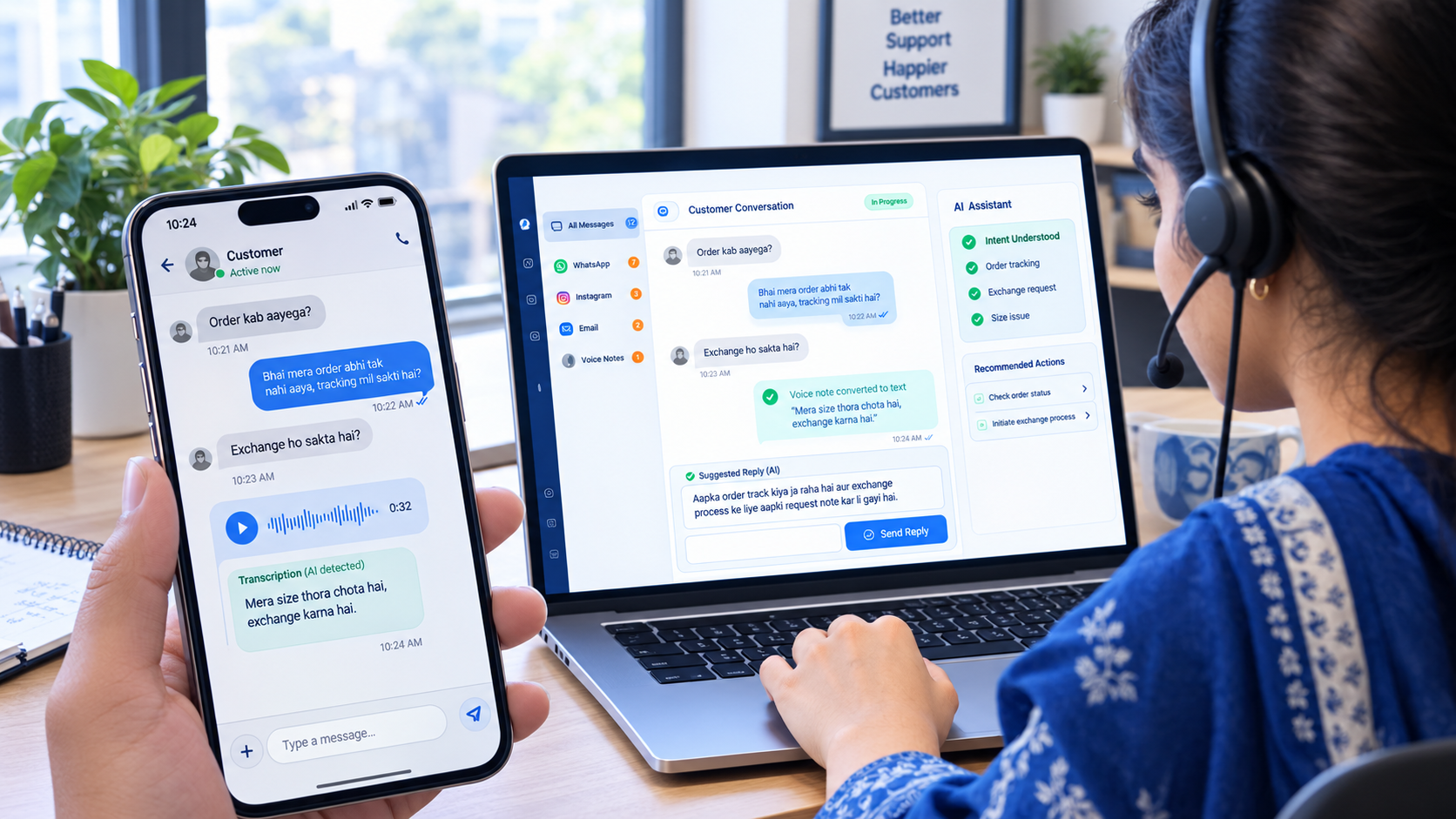
Handling Roman Urdu, mixed language and voice notes
Modern AI models handle Roman Urdu and Urdu-English mixed messages reasonably well, and Onic's launch shows it works at scale. But accuracy depends on your customers' spelling and your industry's slang, so test on your own chat history before going live.
The same word arrives in many forms: "kitne", "kitnay", "ktny". Product names get shortened. A clothing customer writes "lawn ka 3 piece", an electronics customer writes "charger wala". Here's a practical test:
- Export 100 to 200 real support conversations from the last month.
- Run them through the AI and mark where it misread what the customer wanted.
- Add examples or clear fallback replies for those phrases.
- Re-test until misreads drop to a level your team is comfortable with.
Voice notes need one extra step. The audio is transcribed into text first, then it goes through the same workflow. It works, but check accuracy on real customer recordings with background noise before you promise it. The pillar guide covers Urdu and Roman Urdu handling in more depth if you need it.
When should AI hand the conversation to a human?
AI should hand over whenever a wrong answer would cost more than a short wait: complaints, refunds, payment disputes, and any time the customer asks for a person. Customers are clear on this. In a 2026 Gartner survey of 3,566 customers, 87% said companies using GenAI for service must offer a way to reach a human agent.
The same survey found half of customers say GenAI makes their interactions easier (Gartner, August 2026). So customers aren't against AI. They're against being trapped by it. A bot that keeps saying "I didn't understand, please rephrase" does more damage than having no bot at all.
Set these handover rules before launch, not after the first bad review:
- The customer is angry, abusive or threatening to post a complaint publicly
- The request involves a refund, chargeback or payment dispute
- A parcel is lost, damaged or delivered to the wrong person
- The question is medical, legal or financial advice
- The AI isn't confident it understood the request
- The customer types anything like "human", "agent" or "kisi banday se baat karwao"
How the handover happens matters as much as when. The agent should receive a two-line summary, the order details and the conversation so far, so the customer never has to repeat themselves. Our Chatbot SaaS platform is built around exactly this: a shared human-takeover inbox used by 500 businesses daily, where agents can step into any WhatsApp, Instagram, Messenger, web or email conversation live.
Start with agent assist, not a customer-facing bot
The lowest-risk way to start AI customer support automation is agent assist: the AI drafts replies, summarises long threads and suggests tags, and your support person reviews and clicks send. Customers only ever see a human-approved answer, while your team works noticeably faster.
Most guides skip this step and go straight to a bot talking to customers. That's where bad first impressions come from. Agent assist gives you something better: two to four weeks of real data on how often the AI's draft was right.
Here's what agent assist typically covers:
- Draft replies from your policies, in the language the customer used
- Thread summaries so an agent picking up a long chat reads three lines instead of thirty messages
- Customer context pulled from customer history in your CRM: past orders, open tickets, previous complaints
- Suggested tags and priority so the queue sorts itself
That customer context only works if your systems talk to each other. If order data sits in an ERP and customer data in a CRM, it's worth taking the time to connect your CRM and ERP first. Once the drafts are consistently right for a type of question, switch that type to auto-reply and keep the rest on review.
How do you measure whether AI support is working?
Track five numbers before and after launch: first response time, confirmed resolution rate, escalation rate, repeat contact rate and customer satisfaction. Of these, confirmed resolution matters most, because a conversation that simply ends is not the same as a problem that got solved.
This is where most vendor claims fall apart. Chatbot sellers often quote resolution rates of 60% to 80% or more. Yet a Gartner survey of 5,728 customers found only 14% of service issues were fully resolved through self-service. The gap comes from definitions. Many tools count every chat the customer didn't escalate as "resolved", even when the customer simply gave up and called instead.
|
Metric |
What it tells you |
Warning sign |
|---|---|---|
|
First response time |
How fast a customer gets any useful reply |
Fast replies that don't answer anything |
|
Confirmed resolution rate |
Share of chats where the customer confirms the issue is solved |
Counting silence as success |
|
Escalation rate |
How often the AI hands over to a person |
Very low can mean customers can't reach a human |
|
Repeat contact rate |
Customers coming back within 48 hours about the same issue |
Rising after launch means the AI is closing chats too early |
|
CSAT |
Customer rating after the conversation |
Collect it for AI and human chats separately |
Take a baseline for two weeks before launch. Without the "before" numbers, nobody can prove the "after" is better.
Ready-made support chatbot or custom AI workflow?
A ready-made support chatbot is the right choice when you have one sales channel, standard questions and a small budget. A custom AI workflow makes sense when support needs to look up data across several systems, such as your store, courier, CRM and accounts, or when your handover rules are specific to how your team works.
|
Choose a ready-made tool if... |
Choose a custom workflow if... |
|---|---|
|
Most questions are the same 20 FAQs |
Support needs live order, payment and delivery lookups |
|
You sell on one platform |
You use a store plus CRM, ERP or courier systems |
|
A shared inbox is enough |
You need custom routing, reporting and handover rules |
|
Customer data stays inside the tool |
You need control over where customer data is stored |
It's the same reasoning we use for custom vs ready-made CRM decisions: start with off-the-shelf if it fits, and build only where it doesn't. When you've outgrown a template bot, custom AI agents and workflows let support connect to the rest of your business.
On cost, the main drivers are message volume, the number of channels, how many systems the AI must connect to, and whether you need voice. Any quote that doesn't ask about those four things is a guess.
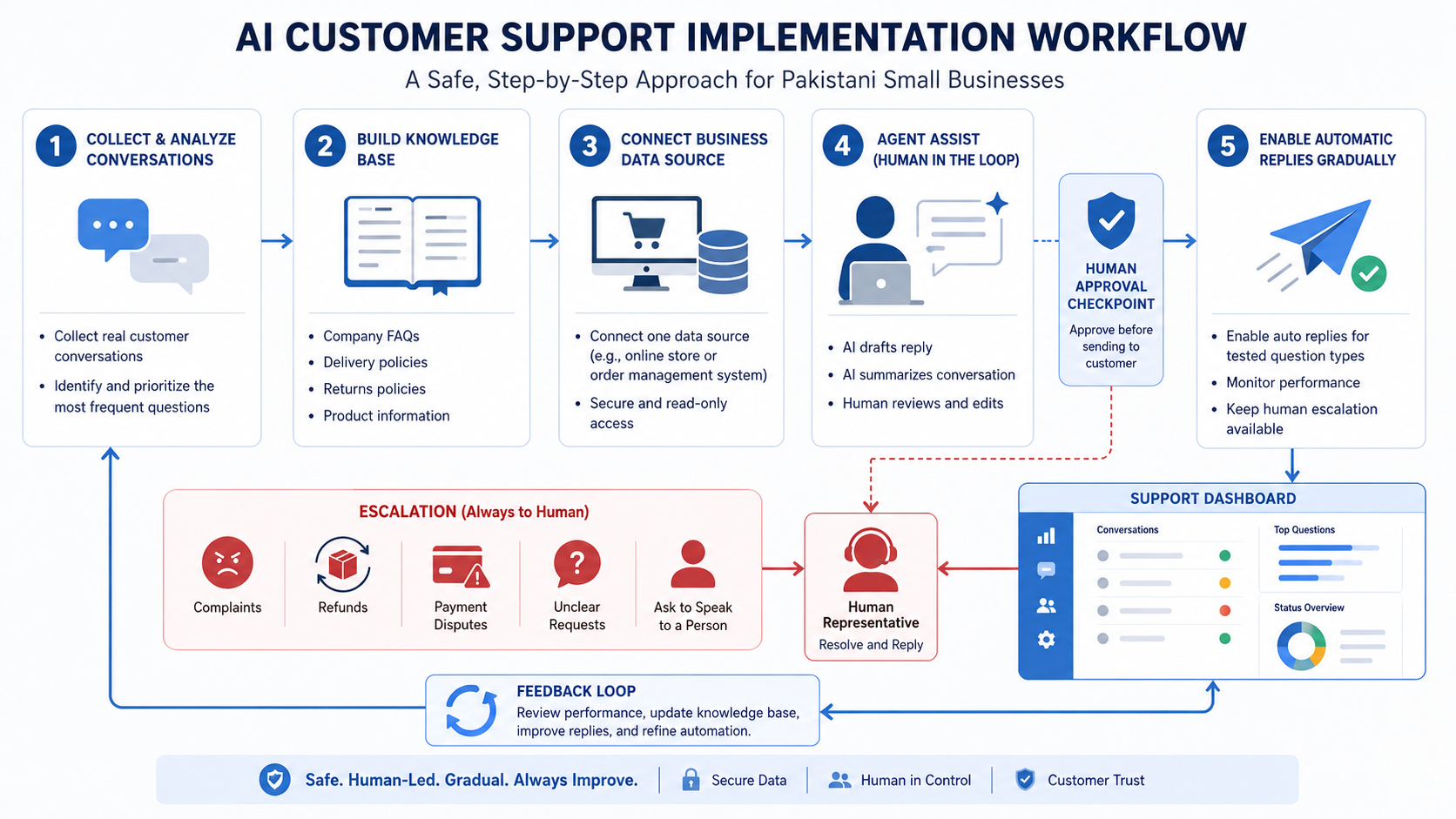
A 5-step rollout for a small support team
Start with one type of question, prove the AI gets it right with a person checking every reply, then expand. Trying to automate every support conversation in the first month is the most common reason these projects stall.
- Export your real conversations. Pull 100 to 200 recent chats and emails. List the top 20 questions and how your best agent answers each one.
- Write the knowledge base. Turn those answers, plus your return, delivery and warranty policies, into short documents the AI can search. Fix any policy your own team answers inconsistently.
- Connect one data source. Usually your store or order system, so the AI can answer "where is my order" with real data.
- Launch as agent assist. The AI drafts, your team approves. Track how many drafts go out unchanged.
- Switch on auto-reply question by question. Once a question type is consistently right, let the AI answer it directly. Keep the handover rules active and review the metrics weekly for the first month.
FAQs
Will AI replace my customer support team?
No. AI takes over the repetitive first layer of support, such as FAQs, order status and ticket sorting, while your team handles complaints, refunds and decisions. Businesses that remove people entirely usually end up with more frustrated customers, not fewer.
What is a good AI resolution rate for customer support?
A good AI resolution rate is one where customers confirm their issue was solved, not just one where the chat ended. Vendor figures often run high, while independent Gartner research found self-service fully resolves far fewer issues, so measure confirmed resolution yourself.
Can an AI support bot understand Roman Urdu?
Yes, modern AI models usually understand Roman Urdu and mixed Urdu-English messages, as Onic's 2026 support launch shows. Accuracy still depends on your customers' spelling and slang, so test the bot on a few hundred of your real past chats before launch.
Do customers in Pakistan accept AI customer support?
Customers accept AI support when it gives fast, correct answers and lets them reach a person easily. In Gartner's 2026 survey, 87% of customers said a human option is essential, so the handover matters as much as the AI itself.
Can AI answer customer phone calls in Urdu?
Yes, AI voice agents can answer calls in Urdu and English, route callers and handle simple lookups like order or booking status. Phone is harder to get right than text, so most businesses start with call routing before letting the AI resolve issues.
Is customer data safe with AI support tools?
Customer data is safe when the setup controls what is sent to the AI model, removes personal details before storing conversations, and keeps logs somewhere you control. Ask any provider where data is stored, who can access it and whether it is used to train models.
How long does it take to set up AI customer support?
Setup time depends on how many channels and systems the AI must connect to. Agent assist or a simple FAQ bot on one channel is quick to launch, while a multi-channel setup with live order and CRM lookups takes noticeably longer.
Start with the question your team answers 40 times a day
Don't start with "let's add AI to support". Start with one question: which message does your team answer over and over, and which delay costs you the most customers?
For an online store it's usually "order kab aayega?". For a clinic it's appointment changes. For a service business it's the same five pricing questions after every ad. Automate that one properly, keep a person on complaints and refunds, measure confirmed resolution, and then add the next question type.
If you want help mapping your first support workflow and connecting it to your store, CRM or phone line, see how we build AI support agents for Pakistani businesses, or book a free automation audit with the Lumen AI team.