Web App Development Cost in Pakistan: What You Pay to Build It and to Run It
13 min read

On this page
- How much does web app development cost in Pakistan?
- What each tier looks like in practice
- What you pay once vs what you pay every month
- Costs billed in dollars
- Provincial sales tax on IT services
- 8 things that change the price of a web app
- Integrations deserve a closer look
- Freelancer, agency or in-house
- How to estimate your own web app budget in 5 steps
- What a good web app quote should include
- Red flags in cheap web app quotes
- Is a custom web app worth it compared with a subscription?
- How Lumen prices web app projects
- Frequently asked questions
- How much does it cost to build a web app in Pakistan?
- Why do web app quotes in Pakistan differ so much?
- How much does web app maintenance cost per year?
- What hidden costs come after a web app is built?
- Is a custom web app cheaper than a SaaS subscription?
- Web app banwane ka kharcha kitna aata hai?
- Get a fixed price for your web app
You send the same app idea to three developers. One quotes PKR 40,000. One quotes PKR 350,000. The third says PKR 1.2 million. You assume two of them are wrong.
Usually none of them is lying. They are pricing three different apps, because each one filled the gaps in your brief with their own guesses.
This guide breaks down web app development cost in Pakistan in 2026, in rupees. You will see typical price ranges by app type, the monthly bills that start after launch, what pushes a quote up, and how to compare three quotes line by line.
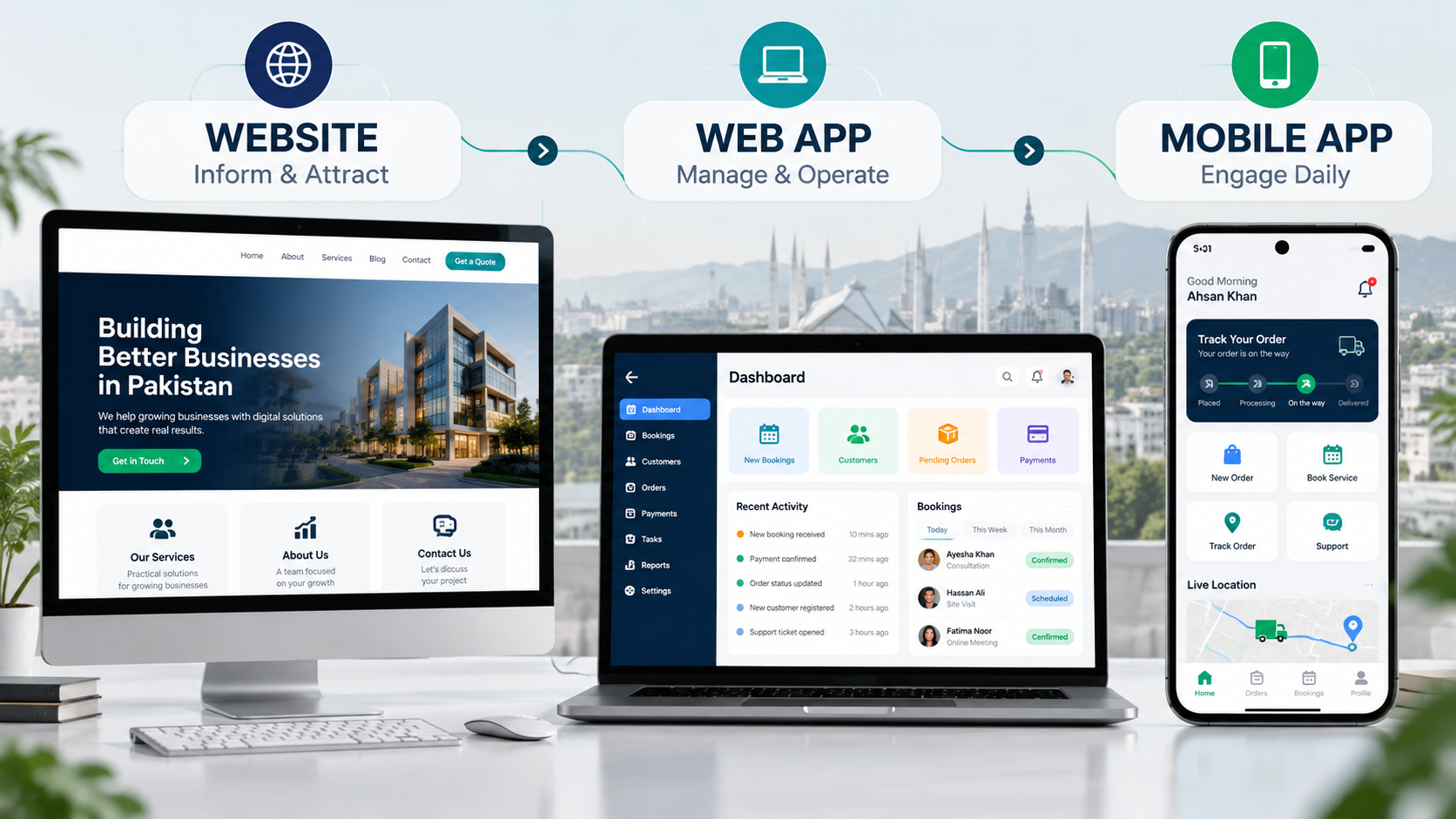
One quick check first. A website tells people about your business. A web app lets people log in and get work done: place orders, approve requests, track stock, download invoices. If you are not sure which one you need, read our comparison of website vs web app vs mobile app before you collect quotes. Web apps cost more because the logic, the data and the permissions all have to be built.
How much does web app development cost in Pakistan?
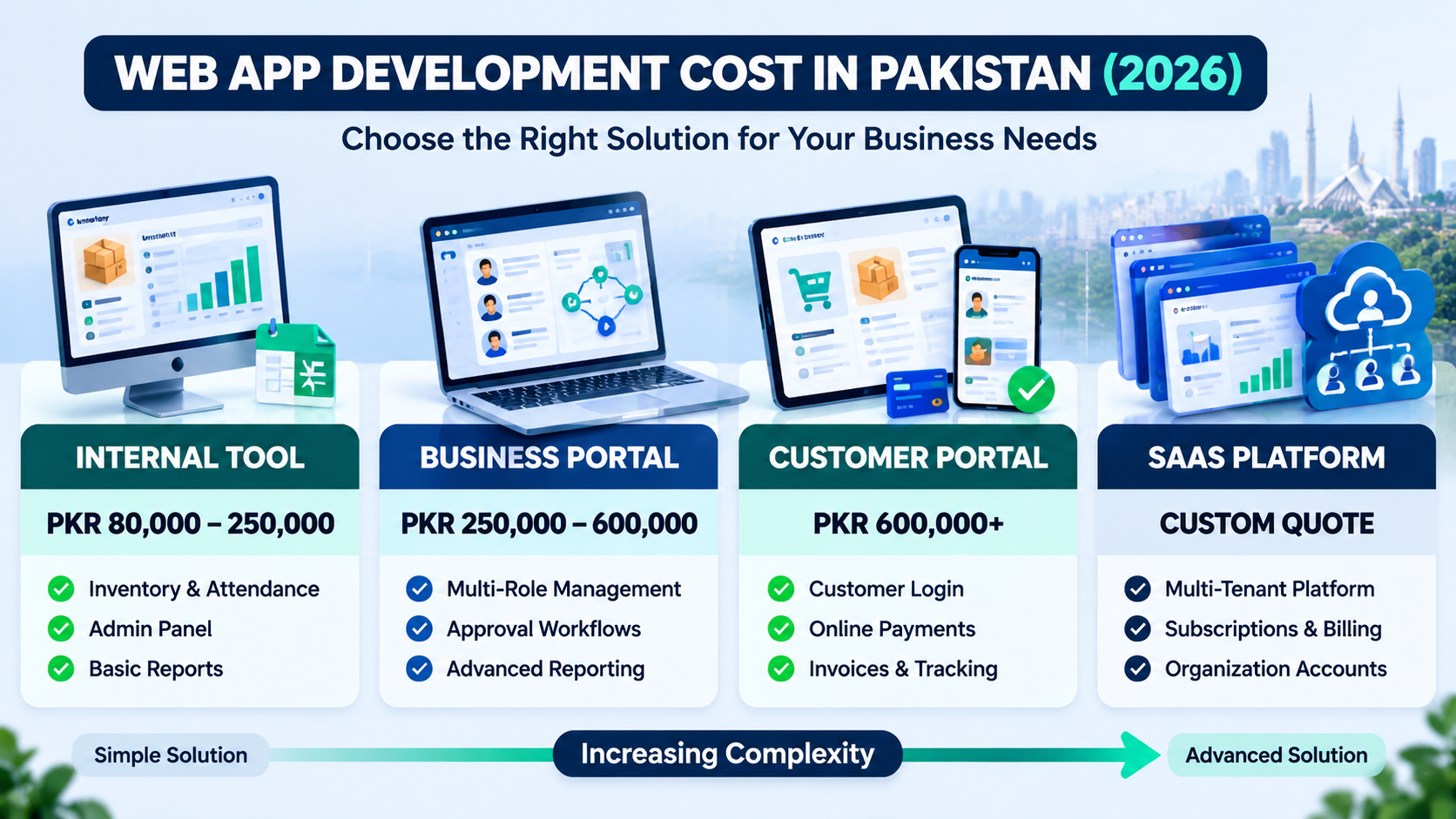
Web app development in Pakistan typically costs PKR 80,000 to PKR 250,000 for a simple internal tool, PKR 250,000 to PKR 600,000 for a multi-role business portal, and PKR 600,000 or more for platforms with payments, many integrations or SaaS billing. Scope decides where you land.
|
App type |
What it usually includes |
Typical market range (PKR) |
Typical timeline |
|---|---|---|---|
|
Single-workflow internal tool |
One core process (inventory, invoicing, attendance, approvals), 2 to 3 user roles, Excel import, basic reports |
80,000 to 250,000 |
4 to 8 weeks |
|
Business portal or dashboard |
Several roles and departments, approval flows, role-based reports, 1 to 3 integrations |
250,000 to 600,000 |
3 to 6 months |
|
Customer or dealer portal with payments |
Customer logins, JazzCash/Easypaisa/card payments, invoices, courier or accounting integrations |
600,000 and up |
3 to 6 months |
|
SaaS or multi-tenant platform |
Separate accounts per business, subscriptions and billing, onboarding, admin console |
Quoted after discovery, usually above the portal tier |
3 to 6 months for a first release |
These are market ranges taken from price lists Pakistani software companies published in 2026, such as Softvirtue's custom software cost guide (PKR 80,000 to 600,000+ for custom software) and agency rate cards that start custom web apps at around PKR 500,000. Timelines follow what Lumen sees on its own projects. Treat the table as a sanity check, not a quote.
What each tier looks like in practice
- Internal tool: the IncorpMe Console is one team's content workspace: a keyword tracker, a content board and an AI writing assistant, with no customer-facing side.
- Business portal: the Certification Business Platform runs certifications, exams, sales and finance for one company, and moved 30,000+ legacy records across. Many roles, many reports, one business.
- SaaS platform: the Chatbot SaaS serves 500 businesses from one deployment, each with its own account and Stripe billing. Multi-tenancy and billing are why SaaS sits at the top of the table.
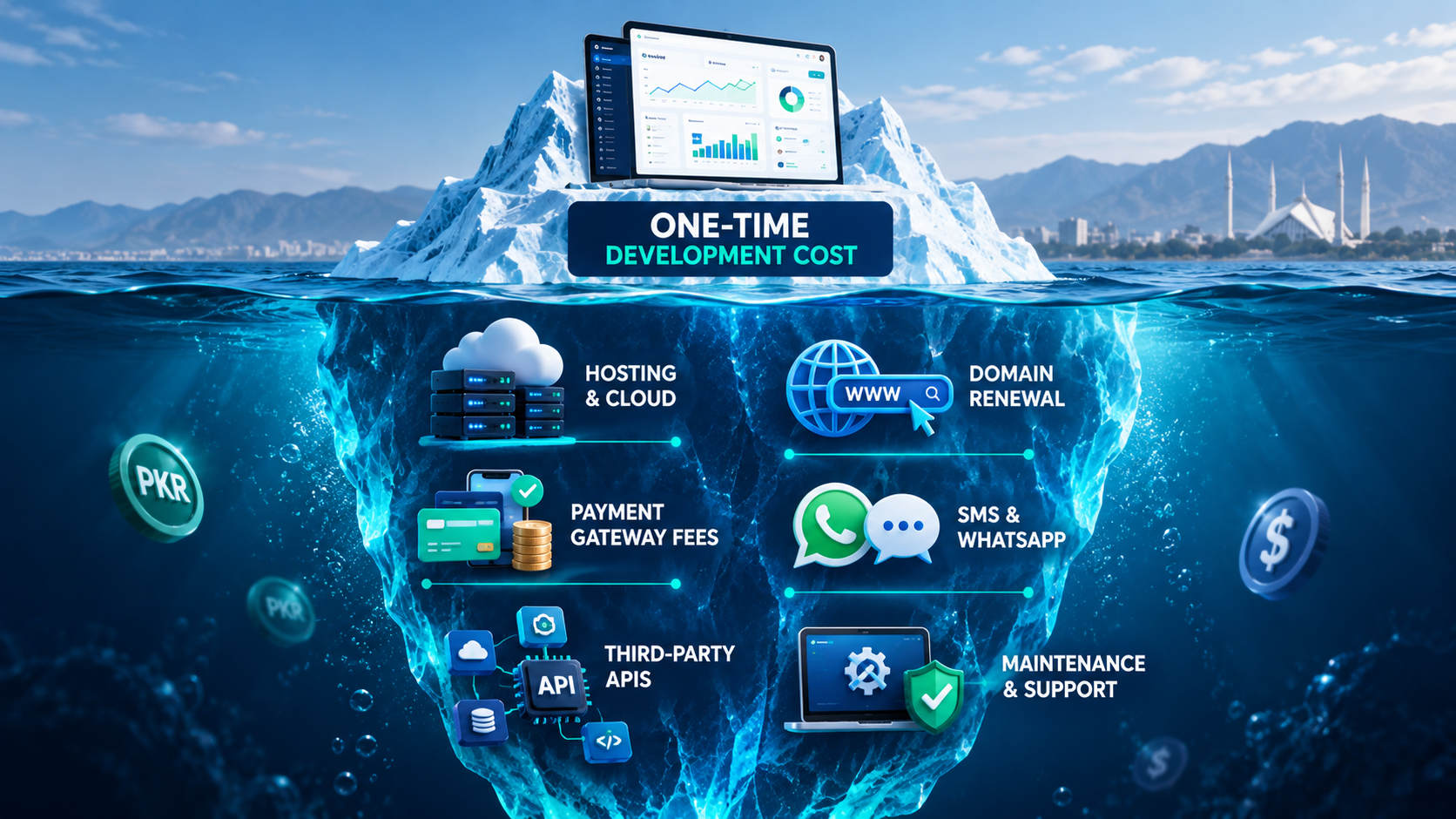
What you pay once vs what you pay every month
The build cost of a web app is paid once, but hosting, domain, payment gateway fees, SMS or WhatsApp messages, third-party APIs and maintenance keep billing you every month or year. Most Pakistani quotes show only the build, so the first-year total surprises people.
Here is what a typical first year looks like for a business web app in Pakistan:
|
Cost item |
Paid |
Typical cost |
Notes |
|---|---|---|---|
|
Development (build) |
Once |
See tier table above |
Ask for milestone payments, not 100% upfront |
|
Domain (.com) |
Yearly |
Around PKR 3,000 to 5,000 |
.pk domains cost slightly less |
|
Hosting (VPS or cloud) |
Monthly or yearly |
From around PKR 30,000 a year, PKR 100,000+ for bigger setups |
Shared hosting is cheaper but rarely right for a web app |
|
SSL certificate |
Yearly |
Often free |
Most modern hosts include it |
|
Payment gateway fees |
Per transaction |
Mobile wallets are commonly quoted at 1.5% to 2.5% per payment |
Plus any setup fee or monthly minimum |
|
SMS / WhatsApp messages |
Per message |
Depends on provider and volume |
OTPs and order alerts add up fast |
|
Third-party APIs (maps, email, AI) |
Monthly |
Varies, often billed in USD |
Some have free tiers that run out as you grow |
|
Maintenance (AMC) |
Yearly |
Often 15% to 20% of build cost |
Bug fixes, updates, backups, small changes |
Ranges above come from published Pakistani price lists (eplanet, Softvirtue) and a payments provider's merchant fee guide. Your own numbers depend on traffic, transaction volume and the providers you pick.
Costs billed in dollars
Cloud servers on AWS or DigitalOcean, AI APIs and many SaaS add-ons charge in USD on a card. Two things follow. Your monthly bill moves with the exchange rate, and a card with a low international limit can fail a renewal and take the app down. We covered card limits and USD billing in our guide to paying for tools in dollars from Pakistan. Ask your developer which parts of the stack bill in dollars before you sign.
Provincial sales tax on IT services
In Pakistan, sales tax on services is collected by the provinces through the Sindh Revenue Board, Punjab Revenue Authority, KPRA and BRA, not by FBR. Rates for IT services differ by province and by scheme. Before comparing two quotes, ask one question: "Is provincial sales tax included in this price?" A cheaper quote that excludes tax may not be cheaper at all.
8 things that change the price of a web app
The price of a web app in Pakistan is driven by eight things: user roles, screens and workflows, integrations, reports, data migration, design, who builds it and the pricing model. Two quotes for "the same app" usually differ on three or four of these, not on the developer's hourly rate.
|
# |
Cost driver |
Why it pushes the price up |
|---|---|---|
|
1 |
User roles and permissions |
Every role (admin, manager, staff, dealer, customer) needs its own screens, rules and testing |
|
2 |
Screens and workflows |
Each approval step, status change or notification is logic someone has to build and test |
|
3 |
Integrations |
JazzCash, Easypaisa, bank IBFT, courier APIs like TCS, Leopards or PostEx, accounting software, CRM or ERP, FBR-linked invoicing: each one is its own mini project |
|
4 |
Reports and dashboards |
Every custom report format is a separate task, and finance reports need extra checking |
|
5 |
Data migration |
Moving years of records from Excel or an old system means cleaning, mapping and verifying them |
|
6 |
Design |
A ready UI kit is quick; a fully custom design with your branding takes more weeks |
|
7 |
Who builds it |
Freelancers, agencies and in-house teams price very differently, and include very different things |
|
8 |
Pricing model |
Fixed price puts the risk on the developer; time and materials puts it on you |
Integrations deserve a closer look
Integrations are where Pakistani projects most often go over budget. A payment gateway needs a merchant account, a sandbox, refunds and failed-payment handling, not just a "Pay" button. A courier API needs booking, tracking and COD reconciliation. If your app will connect to a CRM or ERP system, or add AI features later, plan for that now. Our guide on what AI automation costs covers the AI side separately.
Freelancer, agency or in-house
|
Option |
What you usually get |
What to watch |
|---|---|---|
|
Freelancer |
Lowest price, one person, fast start |
Single point of failure; testing and documentation often thin |
|
Agency |
Team (design, backend, testing, project manager), written scope |
Higher price; check who actually writes the code |
|
In-house team |
Full control, long-term knowledge |
Monthly salaries from day one, plus hiring time |
For context, mid-level web developers in Pakistan earn around PKR 80,000 to 150,000 a month (PNY Trainings, 2026). A three-person in-house team costs more per year than most single web app builds.
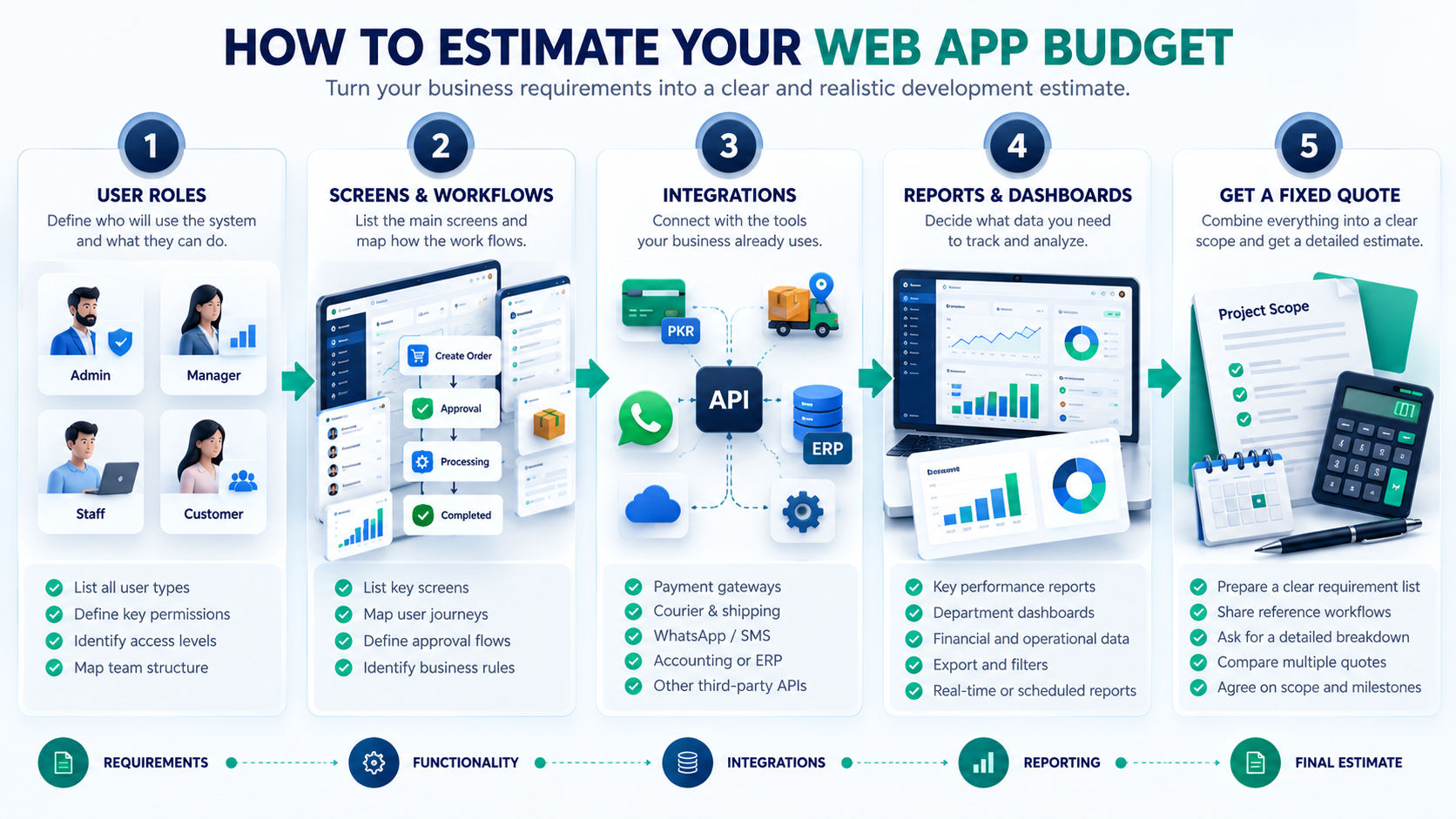
How to estimate your own web app budget in 5 steps
You can estimate a web app budget yourself by listing four things before you talk to any developer: who logs in, which screens they use, which systems it connects to, and which reports you need. That list places you in a price tier and makes every quote comparable.
- List every user role. Write who logs in (owner, manager, staff, dealer, customer) and what each one is allowed to do. One to three roles usually means the internal tool tier.
- List the screens and the steps. Walk through one real day. "Salesman enters order, manager approves, warehouse dispatches, customer gets SMS" is four screens and three notifications.
- List the integrations. Payments, courier, accounting, WhatsApp, your CRM or ERP. Each one moves you closer to the next tier.
- List the reports. Write the exact reports you pull today, with the columns. Bring your current Excel sheets; they are the best specification you have.
- Ask for a fixed quote after a discovery session. Share the list with two or three developers and ask each to quote against it, in phases. Phase one should be the smallest version that saves your team real time.
If you have never scoped software before, our step-by-step guide to building a web app walks through the whole process from idea to launch.
What a good web app quote should include
A good web app quote lists what is in scope and what is not, the payment milestones, who owns the code and hosting, the maintenance terms and the price of changes. If a quote is one line with one number, you cannot compare it with anything.
Use this checklist when three quotes land on your desk:
- Scope in and out. Every role, screen, integration and report listed. Anything not listed is phase two, in writing.
- Milestones and payments. Payment tied to working releases, for example design approved, first module live, final handover.
- Source code ownership. The repository is transferred to you, not just a login to the app.
- Hosting ownership. The server and domain sit on your account, with your card or invoice.
- Testing. Who tests, what gets tested (permissions, payments, reports), and how bugs found after launch are handled.
- Handover and training. Documentation, admin training and a defined warranty period after launch.
- Maintenance (AMC). Yearly cost, what it covers, response time.
- Change-request rate. The price per hour or per change once scope is signed.
- Taxes. Whether provincial sales tax is included.
Red flags in cheap web app quotes
A very low web app quote usually means something is missing, not that the developer is more efficient. Freelance marketplaces list "custom web app" gigs for USD 200 to 300. That buys a template with your logo, not software built around your process.
Watch for these:
- No written scope. "We will build what you need" turns into arguments at every review.
- Code stays with the vendor. You pay for the app but cannot move it, fix it elsewhere or hire someone else later.
- Hosting on the vendor's account. If the relationship ends, your app and your data go with it.
- "Unlimited revisions." Sounds generous, usually means no scope and no end date.
- 100% payment upfront. You lose all leverage before seeing a single working screen.
- No mention of testing. Payments and permissions are exactly where untested apps break.
Is a custom web app worth it compared with a subscription?
A custom web app is worth it when per-user subscription fees keep growing with your team, or when your staff work around the software in spreadsheets and WhatsApp. If a ready-made product already fits your process and you use most of it, keep paying for it.
A quick way to check: a tool charging USD 15 per user a month costs USD 3,600 a year for 20 users, billed in dollars, every year, rising with every hire. A custom app is paid once, then maintenance. One of our clients, a 20-person agency, replaced about USD 1,500 a month of tools with one platform; that project is the Agency OS case study.
The trade-off is time and upfront cost. We compared both routes for sales teams in custom vs ready-made CRM, and the same logic applies to most business software. If you are weighing ERP specifically, see our ERP software pricing guide instead.
How Lumen prices web app projects
Lumen AI prices every web app at a fixed price and fixed timeline, written down after a discovery session and before any code is written. You see working software every week, and the full source code is yours at handover.
How it works in practice:
- Discovery first. We sit with the actual process: the spreadsheets, the WhatsApp approvals, the reports someone rebuilds every Monday.
- Fixed scope. What is in, what is out and what is phase two, in writing.
- Weekly releases. A focused internal tool usually reaches a working first release in 4 to 8 weeks.
- You own it. Repository, configuration and documentation are handed over. No per-seat licence, and a support retainer is optional.
We have delivered 100+ projects for businesses in Pakistan and the Gulf, from our offices in Rahim Yar Khan and Doha. See what we build on our custom web app development page.
Frequently asked questions
How much does it cost to build a web app in Pakistan?
Building a web app in Pakistan typically costs PKR 80,000 to PKR 250,000 for a simple internal tool and PKR 250,000 to PKR 600,000 or more for multi-role portals. The final price depends on user roles, integrations and reports. For a fixed number on your own project, talk to our team.
Why do web app quotes in Pakistan differ so much?
Web app quotes in Pakistan differ because each developer assumes a different scope, team and set of exclusions. One quote may leave out hosting, testing, maintenance or sales tax. Compare quotes against the same written list of roles, screens, integrations and reports.
How much does web app maintenance cost per year?
Web app maintenance in Pakistan is often priced at around 15% to 20% of the build cost per year. That usually covers bug fixes, updates, backups and small changes. New features are normally quoted separately.
What hidden costs come after a web app is built?
The main costs after launch are hosting, domain renewal, payment gateway fees, SMS or WhatsApp messages, third-party APIs and maintenance. Some of these bill in US dollars, so the rupee cost changes with the exchange rate.
Is a custom web app cheaper than a SaaS subscription?
A custom web app is often cheaper over several years when a subscription charges per user and your team keeps growing. If a ready-made product fits your process and the team is small, the subscription is usually the cheaper choice.
Web app banwane ka kharcha kitna aata hai?
Pakistan mein web app banwane ka kharcha aam tor par PKR 80,000 se PKR 250,000 hota hai simple tool ke liye, aur PKR 250,000 se PKR 600,000 ya us se zyada bade portal ke liye. Final price roles, integrations aur reports par depend karti hai.
Get a fixed price for your web app
Send us your process the way it runs today, spreadsheets and all. Lumen AI will come back with the scope, the timeline and one fixed price, before you commit to anything. Get a free build scope or message us on WhatsApp.