Payment Gateway Integration in Pakistan: JazzCash, Easypaisa and Card Payments Explained
16 min read
On this page
- What is payment gateway integration?
- What Pakistani customers actually pay with
- Why Stripe and PayPal aren't the answer for a Pakistani business
- The three ways to integrate payments in Pakistan
- Direct wallet gateways: JazzCash and Easypaisa
- Bank gateways for card payments
- Aggregators: one integration for everything
- What about Raast?
- Payment gateway charges in Pakistan
- Documents you need before you apply
- How payment gateway integration works, step by step
- Mistakes we see in Pakistani checkouts
- Which payment route fits your business?
- Frequently asked questions
- Can I use Stripe in Pakistan?
- How do I add JazzCash to my website? (Website par JazzCash payment kaise lein?)
- Can a sole proprietor get a payment gateway in Pakistan?
- How long does payment gateway approval take?
- Do I need separate integrations for JazzCash and Easypaisa?
- When does the money reach my bank account?
- Is it safe to take card payments on my website?
- Get your checkout right the first time
A customer fills their cart, reaches checkout and sees one option: card. They don't use a card. So they message you on WhatsApp: "JazzCash number bhej dein?" Now your order lives in a screenshot, someone checks the wallet by hand, and the stock count is wrong by evening.
That is the problem payment gateway integration in Pakistan solves.
The short answer: you connect your website or web app to JazzCash, Easypaisa and card payments either directly (one contract per provider), through a bank gateway (mainly for cards), or through an aggregator that covers wallets, cards and bank transfers in one integration. Most businesses pay a 1% to 2.5% fee per transaction, need an NTN and a business bank account to apply, and must have their developer confirm payments from the server, not the browser.
This guide walks through which route fits your business, what it really costs, the paperwork, and how the integration works step by step. If you're still planning the app itself, start with our guide on how to build a web app for your business and come back here when you reach checkout.
What is payment gateway integration?
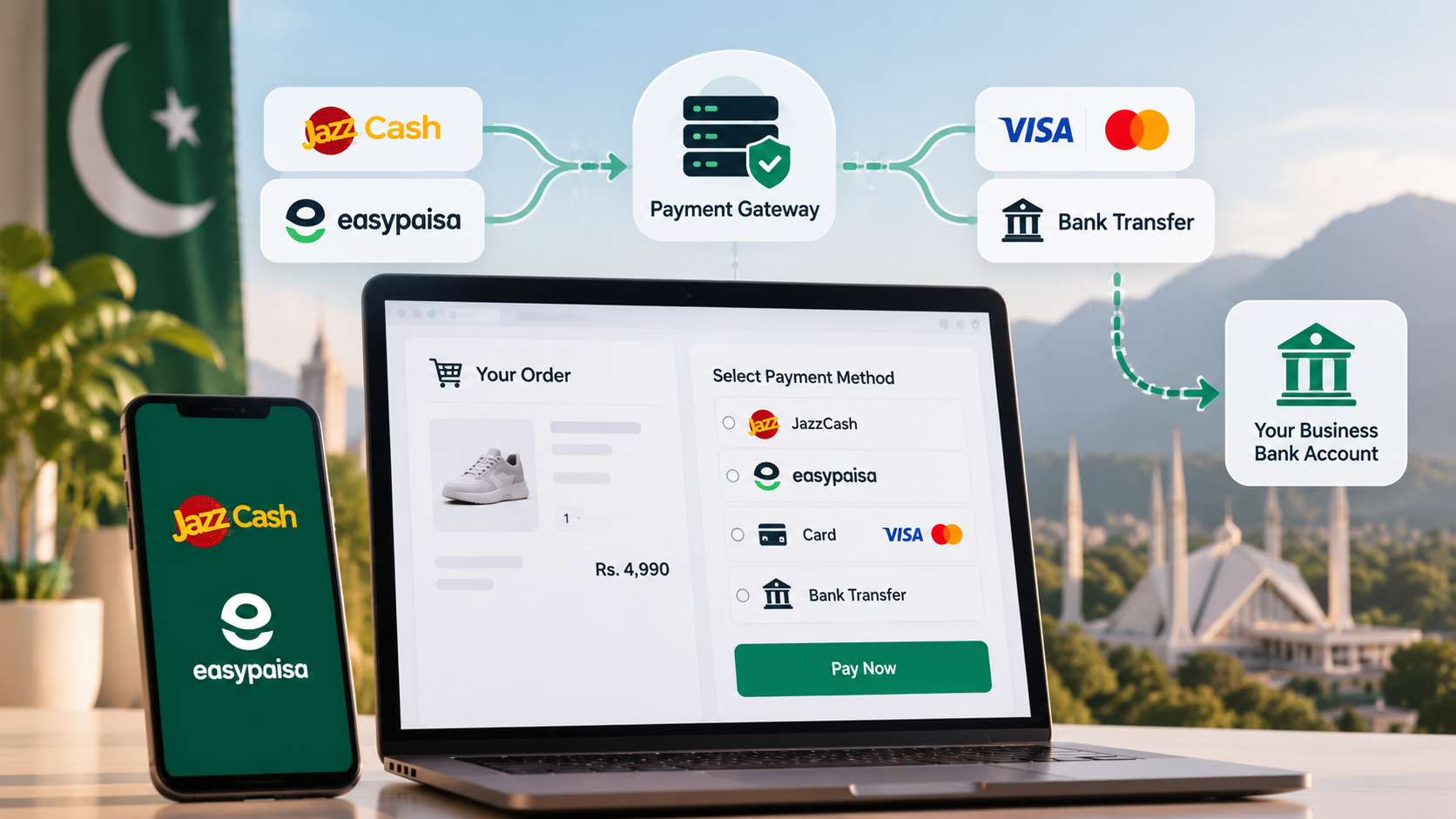
Payment gateway integration means connecting your checkout to a service that takes the customer's payment (wallet, card or bank transfer), confirms it to your system, and settles the money into your business bank account after a fee. Your website never touches the money directly. It sends the order to the gateway, waits for a confirmation, and updates the order.
In Pakistan, the gateway sits between your checkout and three types of payment rails:
- Mobile wallets: JazzCash and Easypaisa, used by millions who don't own a credit card
- Cards: Visa, Mastercard and UnionPay debit and credit cards, through an acquiring bank
- Bank accounts: direct debit, IBFT bank transfers and, increasingly, Raast
Which of these your checkout supports decides how many customers can actually pay you.
What Pakistani customers actually pay with
Pakistani customers pay online mostly through wallets and bank accounts, not cards. According to the State Bank of Pakistan's FY25 payment systems review, 93% of e-commerce transactions in FY25 ran through account and wallet-based channels.
The quarterly numbers make the split even clearer. In Q2 FY25 (October to December 2024), SBP data showed wallets and accounts handled 92% of e-commerce transactions by count but 67% by value. Cards carried only 8% of transactions, yet 33% of the money.
Read that again, because it gives you a simple rule:
- Wallets bring volume. If you sell to the public at everyday prices, JazzCash and Easypaisa are not optional. Without them, most of your buyers fall back to cash on delivery or a WhatsApp transfer.
- Cards bring ticket size. Customers paying larger amounts (B2B invoices, annual fees, courses, software subscriptions) are more likely to use a card. If your average order is high, cards deserve more attention than their transaction share suggests.
Online prepayment also helps outside the checkout. Every order paid upfront is one less cash-on-delivery parcel that can come back refused. We covered that side in detail in AI automation for online stores in Pakistan.
Key takeaway: Support at least one wallet and cards from launch. Supporting both JazzCash and Easypaisa is better, because each has customers who won't download the other app just to pay you.
Why Stripe and PayPal aren't the answer for a Pakistani business
Stripe and PayPal don't let Pakistan-registered businesses receive payments, so they aren't an option for a local checkout. You'll find pages online claiming otherwise. Pakistani merchants who try usually hit a rejected application or a limited account.
Even if they did work, they would solve the wrong problem. Your local customers mostly pay through wallets and bank accounts, and Stripe and PayPal don't connect to JazzCash or Easypaisa.
Some founders register a company abroad to use Stripe for international customers. That is a separate decision with its own tax and banking questions, so speak to an accountant before going down that road. For selling to customers inside Pakistan, a local gateway or aggregator is the practical route.
The three ways to integrate payments in Pakistan
You can integrate payments in Pakistan in three ways: directly with each wallet, through a bank's card gateway, or through an aggregator that bundles wallets, cards and bank transfers into one connection. Here is how they compare.
|
Route |
Payment methods |
Setup effort |
Dashboards |
Best for |
|---|---|---|---|---|
|
Direct wallet gateways (JazzCash, Easypaisa) |
One wallet per contract (some add cards and vouchers) |
Separate application and integration for each |
One per provider |
Businesses that want direct relationships and lowest wallet fees |
|
Bank gateway |
Cards (some banks add their own account payments) |
Longer onboarding with the acquiring bank |
One |
High-value orders and B2B invoices paid by card |
|
Aggregator (e.g. Safepay, PayFast, XPay, Simpaisa, Paymob) |
Wallets, cards and bank transfers together |
One application, one integration |
One |
Most new web apps and stores that want everything live at launch |
None of these is "best" for everyone. The right one depends on your order size, your customers and how much your team wants to manage.
Direct wallet gateways: JazzCash and Easypaisa
Going direct means signing a merchant agreement with JazzCash, Easypaisa or both. Each one reviews your business separately and gives you your own credentials. For JazzCash, that typically means a merchant ID, an API password and an integrity salt that your server uses to sign and verify each payment request.
The upside is a direct relationship and published pricing. Easypaisa, for example, lists its online payment gateway charges as 1% for mobile account payments and 2% for over-the-counter token payments, taxes included.
The downside is duplication. Two wallets mean two applications, two integrations, two sandboxes to test and two settlement reports to reconcile every day.
Bank gateways for card payments
To accept Visa and Mastercard directly, you work with an acquiring bank that offers an online payment gateway. The bank checks your business, sets up your merchant account and gives you integration details. Cards are verified with 3D Secure, where the customer confirms the payment with an OTP from their bank.
Card fees are negotiated per merchant, so get a written quote. Bank onboarding usually takes longer than a fintech aggregator, but it suits businesses with larger tickets and an existing banking relationship.
Aggregators: one integration for everything
An aggregator is a licensed payment company that has already connected to the wallets, card networks and banks. You integrate once, and your checkout offers JazzCash, Easypaisa, cards and often bank transfers on a single page. You also get one dashboard and one settlement report.
The trade-off: there is a middle layer between you and the wallet, and its fees and settlement terms apply. Compare at least two aggregators on the same points: which methods are live (not "coming soon"), fee per method, settlement time, refund support, recurring billing and the quality of their sandbox and documentation.
What about Raast?
Raast is the State Bank's instant payment system, and it is growing fast. It processed 1.28 billion transactions worth PKR 29.6 trillion in FY25, according to Profit's report on SBP data. Raast payments move straight between bank accounts, which makes them attractive for online checkouts. When you shortlist a gateway, ask whether it supports Raast payments today and what it costs. Don't plan your launch around a feature that is still on a roadmap.
Payment gateway charges in Pakistan
Payment gateway charges in Pakistan are mostly a percentage of each transaction, called the Merchant Discount Rate (MDR). Wallet payments typically cost 1% to 2.5%, card fees are quoted per merchant, and some providers add setup fees or monthly minimums. Settlement time and refund rules are the hidden costs.
|
Cost |
What to ask |
Example |
|---|---|---|
|
MDR on wallets |
Fee per JazzCash and Easypaisa payment, taxes included or not |
Easypaisa lists 1% (mobile account) and 2% (OTC token) |
|
MDR on cards |
Fee for local and international cards, debit vs credit |
Quoted per merchant |
|
Setup and monthly fees |
One-time onboarding fee, monthly minimum, annual charges |
Ask for it in writing |
|
Refund cost |
Is the MDR returned when you refund? |
JazzCash's Q1 2026 schedule of charges charges no MDR on same-day refunds, but does on later ones |
|
Settlement time |
When money reaches your bank account, per method |
Easypaisa: mobile account daily and instant, OTC token 7 working days |
Two things owners miss:
- Slow settlement is a cost. If a method settles in a week, that money is not in your account to pay suppliers. For a business running on tight cash flow, a slightly higher fee with next-day settlement can work out cheaper.
- Refund timing changes your fee. If your gateway charges MDR on later refunds, a slow refund process costs you money on every cancelled order.
Gateway fees are only one part of running a web app. For the full picture, including build cost, hosting and maintenance, see our breakdown of web app development cost in Pakistan.
Documents you need before you apply
To apply for a payment gateway in Pakistan you usually need an NTN, a business bank account, CNIC copies for KYC, and a live website or app with clear policies. Exact requirements vary by provider and business type, so confirm the list with your chosen gateway before you start.
|
Sole proprietor |
Registered company (Pvt Ltd or partnership) |
|---|---|
|
Owner's CNIC |
CNICs of directors or partners |
|
NTN in the owner's or business name |
Company NTN |
|
Business bank account (not a personal one, where the provider requires it) |
Company bank account |
|
Proof of business (letterhead, utility bill or registration) |
SECP incorporation certificate or partnership deed |
|
Live website or app URL |
Live website or app URL |
Your website matters as much as the paperwork. Reviewers check that the site looks like a real business. Before applying, make sure these pages are live:
- Real product or service pages with prices in PKR
- Refund and cancellation policy
- Terms of service and privacy policy
- Contact page with phone, email and business address
Applications with a half-finished site or missing refund policy are a common reason for delays. Get these pages published first, then apply.
How payment gateway integration works, step by step
Payment gateway integration works in six steps: choose your route and apply, build the checkout in the sandbox, confirm payments from your server, track every payment state, test every method, and reconcile daily after launch. You don't need to write the code yourself, but you should know what your developer must get right.
- Choose your route and apply. Pick direct, bank or aggregator using the table above, then submit your documents. Ask for sandbox (test) access at the same time so development doesn't wait for approval.
- Build the checkout in the sandbox. Your developer connects your order flow to the gateway's test environment. For most businesses we recommend hosted checkout, where the customer enters wallet or card details on the gateway's secure page. Card data never touches your server, which keeps your security burden much lower.
- Confirm the payment from your server. This is the step most often done wrong. When a customer pays, the gateway sends them back to your site (the redirect) and separately sends your server a signed message (a callback, also called a webhook or IPN). Your system should mark the order as paid only after it receives and verifies that server message. Customers close tabs, lose signal mid-payment, and redirects can be tampered with. The server message is the proof.
- Track every payment state. An order is not just "paid" or "not paid". Store each status: pending, paid, failed, cancelled and refunded. This is what lets your team answer "did my payment go through?" in ten seconds instead of checking the wallet app by hand.
- Test every method and every failure. Run a test payment with a card, JazzCash, Easypaisa and bank transfer. Then test what goes wrong: a failed payment, a customer who closes the page, a wallet OTP that times out, a double click on "Pay", and a refund. Each should leave the order in the right state.
- Go live, then reconcile daily. After approval, switch to live credentials and make one small real payment yourself. From then on, match your orders against the gateway's settlement report every day. A mismatch caught on day one is a five-minute fix. Caught at month end, it is an afternoon in Excel.
Payments are one feature inside a bigger build. If your checkout sits inside a customer portal, booking system or internal tool, our custom web app development team builds the payment flow, order states and reconciliation as part of the app, not as an afterthought.
Mistakes we see in Pakistani checkouts
The most common checkout mistakes in Pakistan are marking orders paid on the browser redirect, offering only one wallet, and having no refund or retry flow. Each one either loses sales or creates manual work later.
- Trusting the redirect. The order shows "paid" because the customer landed on the thank-you page, but the payment actually failed. You ship, and the money never arrives.
- Only one wallet. A JazzCash-only checkout tells every Easypaisa user to go away, and the reverse is just as true.
- No retry when a wallet payment times out. Wallet payments often need the customer to approve in their app within a short window. If they miss it, the checkout should offer "try again" or another method, not a dead end.
- No refund flow. Refunds handled by sending money from a personal wallet leave no record against the order, and on some gateways a late refund still costs you the fee.
- Storing card details yourself. Use hosted checkout or the gateway's secure fields. Never save card numbers in your own database.
- No backup gateway. If your only gateway has an outage on a sale day, you lose the day. For high-volume stores, a second route (even just a wallet direct integration alongside an aggregator) is cheap insurance.
One more that isn't technical: sending payment links by hand over WhatsApp. It works at ten orders a day and breaks at a hundred. If WhatsApp is where your customers already talk to you, WhatsApp AI automation can send the right payment link automatically and update the order when it's paid.
Which payment route fits your business?
For most new Pakistani web apps and stores, an aggregator is the fastest way to accept wallets and cards from day one. Direct wallet or bank integrations make more sense once you have volume to negotiate fees, or when your customers mostly pay large amounts by card.
|
Your business |
Start with |
Why |
|---|---|---|
|
Online store selling to the public |
Aggregator with JazzCash, Easypaisa and cards |
Wallets bring most orders, one integration gets you live fastest |
|
B2B portal with large invoices |
Bank gateway for cards, plus bank transfer or Raast |
Bigger tickets, buyers pay from business accounts |
|
Subscription or SaaS product |
Aggregator or bank gateway that supports recurring billing and saved cards |
Wallets don't suit automatic monthly charges as easily as cards |
|
School, clinic or academy collecting fees |
Aggregator or direct wallet, plus payment links |
Parents and patients pay from their phones, links work over WhatsApp and SMS |
Running an online store? Payments connect to everything else: order confirmations, courier booking and stock. Our ecommerce and marketplace automation work ties those together. And if you're not sure whether you need a full web app or just a website with a checkout, read website vs web app vs mobile app first.
Frequently asked questions
Can I use Stripe in Pakistan?
No, not as a Pakistan-registered business. Stripe doesn't onboard Pakistani merchants, and it doesn't connect to JazzCash or Easypaisa anyway. For local customers, use a Pakistani gateway or aggregator. Setting up a foreign company to use Stripe is a separate decision with its own tax questions.
How do I add JazzCash to my website? (Website par JazzCash payment kaise lein?)
Apply for a JazzCash merchant account or sign up with an aggregator that includes JazzCash. Once approved, you get merchant credentials and sandbox access. Your developer connects the checkout, tests it, then switches to live credentials. On WordPress or Shopify, a plugin or app may handle most of this.
Can a sole proprietor get a payment gateway in Pakistan?
Usually yes. Most providers accept sole proprietors with a CNIC, an NTN, a business bank account and a live website. Requirements differ between gateways, so check the exact list before applying, and make sure your refund policy and contact page are live.
How long does payment gateway approval take?
It depends on the provider and how complete your application is. Missing documents and unfinished websites are the usual causes of delay. Apply with everything ready, request sandbox access at the same time, and your developer can build while the review runs.
Do I need separate integrations for JazzCash and Easypaisa?
If you go direct, yes: two agreements, two integrations and two settlement reports. An aggregator covers both, plus cards, through one integration. That is why most new businesses start with an aggregator and add direct integrations later if volume justifies it.
When does the money reach my bank account?
It depends on the payment method and your agreement. Easypaisa, for example, settles mobile account payments daily and instantly, but over-the-counter token payments take 7 working days. Card settlement terms are set in your gateway contract, so ask before you sign.
Is it safe to take card payments on my website?
Yes, if you use hosted checkout or the gateway's secure payment fields. The customer enters card details on the gateway's side, so card numbers never reach your server. Never store card details in your own database, and keep cards confirmed with 3D Secure.
Get your checkout right the first time
A checkout that takes JazzCash, Easypaisa and cards, confirms every payment from the server and reconciles itself is not a luxury. It is the difference between orders that close and orders that drift into WhatsApp screenshots.
Lumen builds custom web apps with payments wired in from day one: gateway selection, sandbox testing, payment states, refunds and daily reconciliation. Tell us what you're building and how your customers pay, and we'll suggest the simplest route that works. Talk to us about your checkout.