How to Choose a Software House in Pakistan
15 min read
On this page
- Before you contact anyone: know what you're buying
- Write a one-page brief
- Decide what kind of product you need
- Where to find software development companies in Pakistan
- How to verify a software house in Pakistan in 30 minutes
- The 8-point checklist for comparing software houses
- What the best software house in Pakistan does differently
- 12 questions to ask a software house before hiring
- Red flags that should end the conversation
- Fixed price, hourly or dedicated team: which pricing model fits?
- The contract: seven clauses that protect you
- Software house, freelancer or in-house team?
- Hiring a Pakistani software house from Qatar or the GCC
- How we run projects at Lumen AI
- Frequently asked questions
- How do I check if a software house in Pakistan is genuine?
- Is PSEB registration required for a software company in Pakistan?
- What questions should I ask a software development company before hiring?
- Should I pay a software house upfront in Pakistan?
- Who owns the source code after a software project?
- How much does a software house charge in Pakistan?
- Get a second opinion on your project
You send the same app idea to three software houses. One sends a polished PDF and a fixed price within a day. One wants a call first. The third replies on WhatsApp with a number and "50% advance to start."
You pick the one that feels safest. Six weeks later the demo still isn't ready, the developer you spoke to has "moved to another project," and the code sits on a server you can't log into.
This happens a lot, and it's rarely bad luck. Pakistan has more than 34,000 IT companies registered with SECP (Economic Survey via APP). Good ones and weak ones look almost identical on a website. The difference shows up in how they answer a few specific questions.
Here's the short answer:
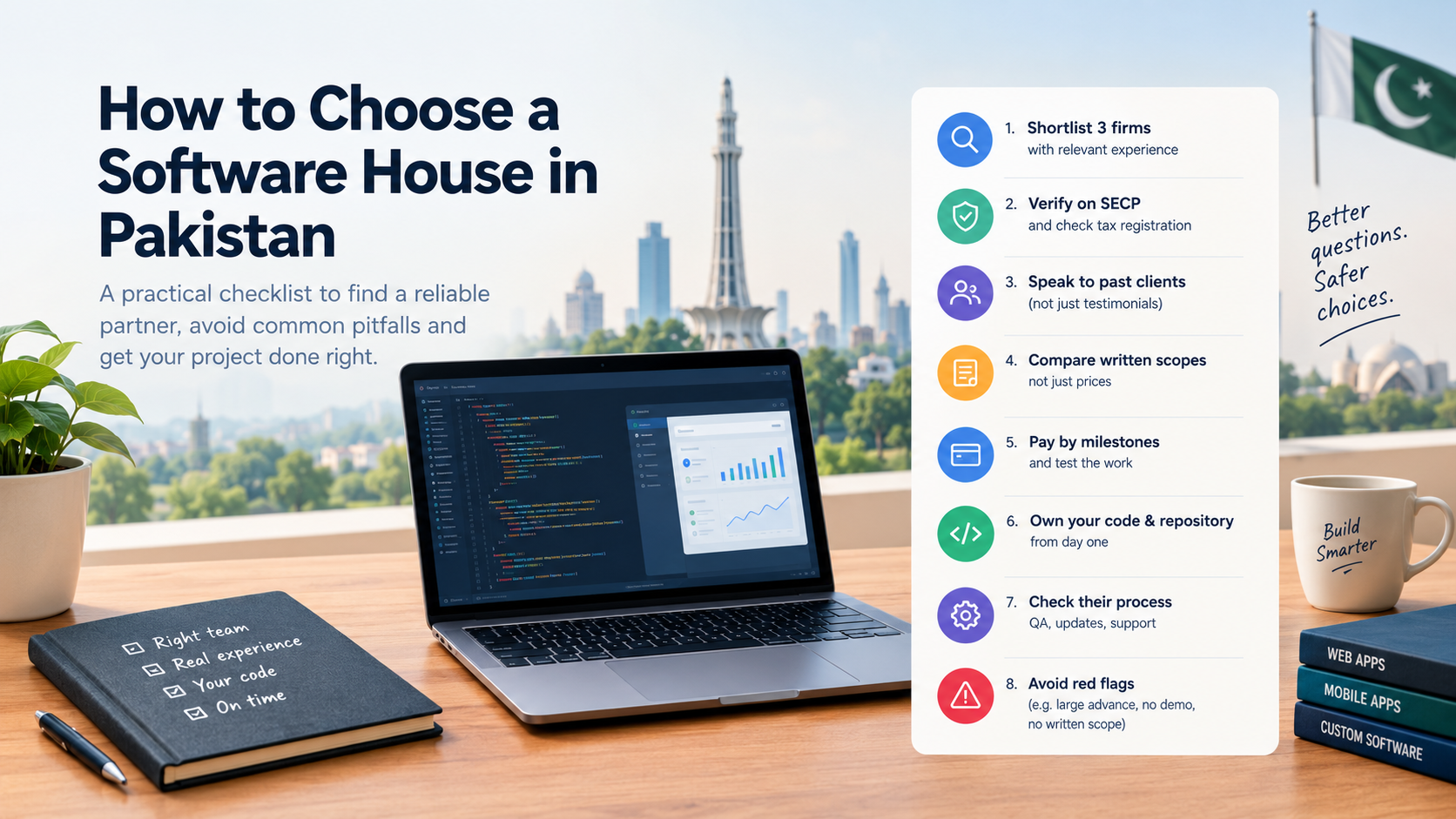
To choose a software house in Pakistan, shortlist three firms that have built something similar to your project, verify them on SECP, speak to two of their past clients, compare written scopes instead of prices, pay by milestones, and make sure you own the code and repository from day one.
The rest of this guide shows you how to do each step. We build custom software ourselves, so think of this as the checklist we'd want you to use on us, too.
Before you contact anyone: know what you're buying
The best way to compare software houses is to send all of them the same one-page brief. Without one, every quote is priced against a different guess of your project. You end up comparing guesses, not companies.
Write a one-page brief
It doesn't need to be technical. Cover five things:
- The problem. "Our orders are tracked in three Excel files and WhatsApp" beats "we need an ERP."
- Who will use it. Staff, customers, dealers, or all three.
- Must-have features. Five to ten, ranked. Nice-to-haves go in a separate list.
- Budget range in PKR. A range, not a single number. It saves both sides a week.
- Deadline and why. A launch date tied to a season or an event is real. "ASAP" isn't.
If you want a fuller walkthrough, our step-by-step guide to building a business web app covers scoping in more detail.
Decide what kind of product you need
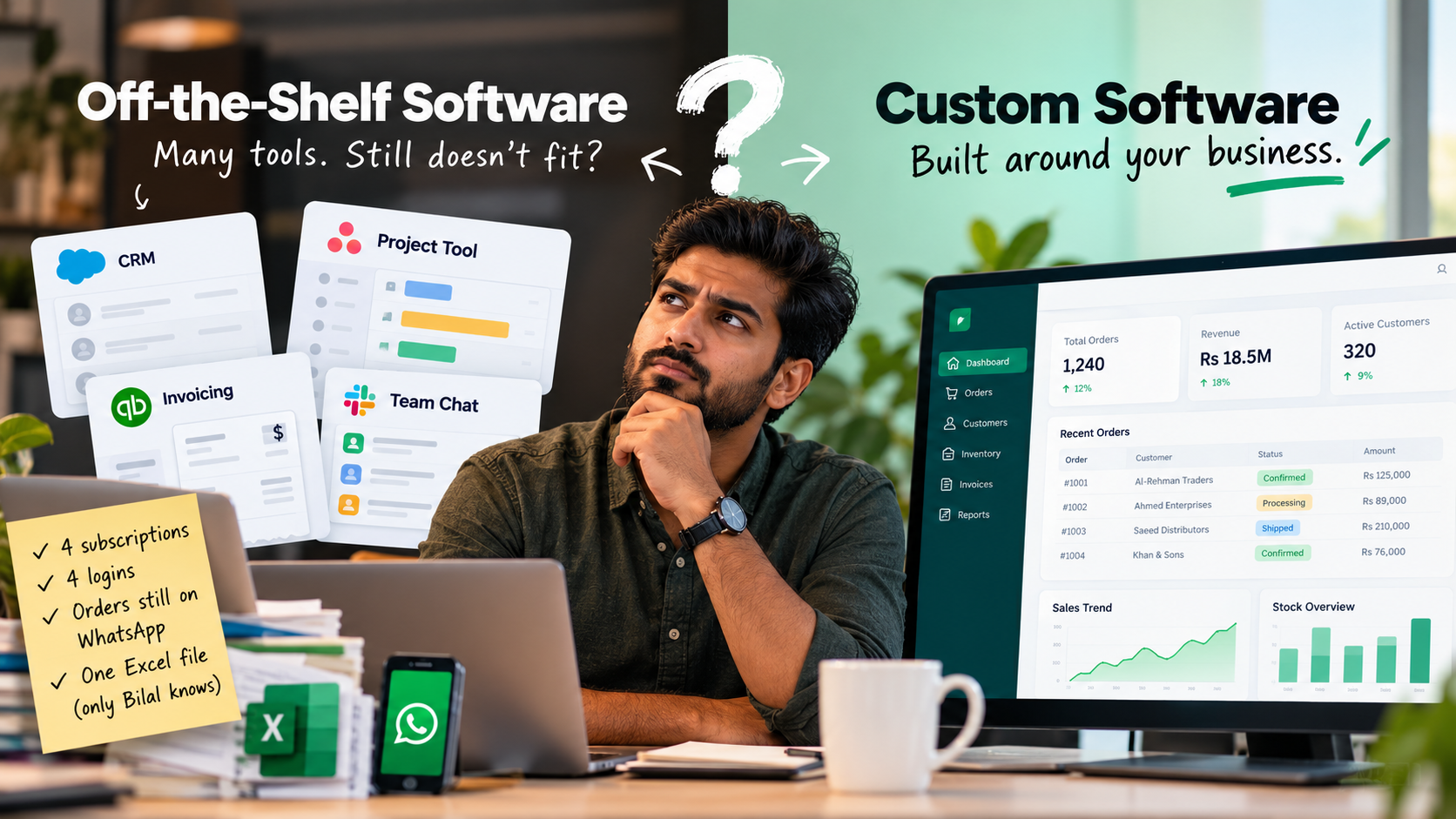
A lot of bad quotes come from buyers asking for the wrong thing. Some businesses ask for a mobile app when a web app would do the job at half the cost. Others pay for custom code when a ready-made tool would have worked fine. Spend ten minutes on whether you need a website, web app or mobile app, and check whether you need custom software at all before you start collecting quotes.
Where to find software development companies in Pakistan
Start with referrals from businesses like yours. Then use directories to widen the list, and don't trust a directory's ranking on its own. Pakistan's software houses are concentrated in Lahore, Karachi and Islamabad/Rawalpindi, but location matters less than process now that most projects run on video calls.
- Referrals. Ask two or three business owners in your industry who built their system. A referral tells you how the firm behaves after launch, which no website will.
- Directories. Clutch, GoodFirms and DesignRush list hundreds of Pakistani firms with reviews and hourly rates. Some placements on these sites are paid, so read the reviews rather than the rank.
- P@SHA member list. The Pakistan Software Houses Association lists member companies. Membership means the firm is an organised business, not that its work is good.
- LinkedIn. Look at the company page and the people who work there. A firm that claims 50 developers but shows 6 employees is telling you something.
Aim for a shortlist of three. Fewer and you have nothing to compare. More and you won't have time to check each one properly.
How to verify a software house in Pakistan in 30 minutes
You can check whether a Pakistani software house is real and reliable in about half an hour, before you sign anything. Confirm it is a registered company, confirm its people exist, then hear from its past clients and see its work running. Skip any one of these and you're trusting a sales pitch.
- Search the company on SECP. Use the company name search on SECP's eServices portal (secp.gov.pk). A private limited company should show up with its registered name and status. Many solid small firms are sole proprietors or partnerships, so a missing SECP record isn't automatically a red flag. But the name on your contract should match a real, checkable business.
- Check their tax registration. Ask for the firm's NTN and look it up on FBR's Active Taxpayer List. A business that can't or won't share an NTN will struggle to give you a proper invoice.
- Ask about PSEB registration, and know what it means. The Pakistan Software Export Board registration is voluntary. Firms register mainly for tax benefits on export income, and PSEB is not a regulator (PhoneWorld). A PSEB certificate shows the firm is organised. It says nothing about code quality.
- Match the team to the claims. Compare the headcount on the website with the people on LinkedIn. Ask who would actually work on your project and look them up.
- Call two past clients. Not testimonials on the website, actual phone numbers. Ask: Did they hit the deadline? What went wrong, and how did they handle it? Would you hire them again?
- Log into something they built. Screenshots can be borrowed. Ask for a demo login to a live system similar to yours, or a screen-share where they click through it.
One thing to keep straight: SECP, FBR and PSEB records prove a company exists. Only steps 5 and 6 tell you whether it delivers. Most buyers stop at the certificates, and that's exactly where weak vendors are strongest.
The 8-point checklist for comparing software houses
Once your three firms pass verification, compare them on how they work, not on how they present. Use these eight points. A firm that does well on six or more is worth a serious conversation, whatever its size.
|
# |
What to check |
What good looks like |
How to check it |
|---|---|---|---|
|
1 |
Similar past work |
Built at least one system close to yours (same industry or same type of app) |
Ask for the case study, then the client's number |
|
2 |
Discovery before pricing |
Asks detailed questions before quoting; may offer a paid scoping phase |
Notice who asks more questions in the first call |
|
3 |
Named team |
Tells you who will build it and lets you speak to the senior developer |
Ask "Who exactly will write the code?" |
|
4 |
Tech stack fit |
Explains its stack choice in terms of your needs, not fashion |
Ask why Laravel or Node.js, for example, suits your project |
|
5 |
Testing (QA) |
Has a tester or a written testing process; uses a staging server |
Ask to see a bug report from a past project |
|
6 |
Project updates |
Fixed weekly update, a shared task board, demos every 1 to 2 weeks |
Ask what you will see every Friday |
|
7 |
Support after launch |
Written warranty period and a monthly support option |
Ask what a bug fix costs in month three |
|
8 |
Clear pricing |
Line-item quote tied to the scope, with what's excluded |
Compare exclusions, not just the total |
What the best software house in Pakistan does differently
The best software house for your project usually isn't the biggest or the cheapest. It's the one that pushes back. Good firms tell you when a feature isn't worth building, when your deadline is unrealistic, or when an off-the-shelf tool would serve you better.
Watch for that in the first call. A vendor that agrees with every feature, every date and every budget has either not understood your project or doesn't plan to deliver all of it. A vendor that says "let's cut these three features from version one" is protecting your money.
12 questions to ask a software house before hiring
Ask every firm on your shortlist the same twelve questions, ideally on a call with the person who will lead your project. The answers matter, but so does how they answer: clear and specific is good, vague and rushed is a warning.
- Have you built something like this before? Can I speak to that client?
- Good answer: a named project and a phone number.
- Who exactly will work on my project, and how senior are they?
- Good answer: names, roles, and a call with the lead developer.
- How do you price changes once we've started?
- Good answer: a written change-request process with a rate or estimate per change.
- What's not included in this quote?
- Good answer: a clear list. Hosting, third-party fees, content entry and app store accounts are common exclusions.
- How will I see progress?
- Good answer: a staging link you can click through, plus regular demos.
- How do you test before delivery?
- Good answer: a tester or test process, and a bug-fixing round before each payment.
- Who owns the code, and whose GitHub or GitLab account is it in?
- Good answer: you own it, in writing, and the repository sits in your account (or is transferred at each milestone).
- Where will it be hosted, and whose name is the account under?
- Good answer: your account, with their access added.
- What does the payment schedule look like?
- Good answer: a modest advance, then payments tied to milestones you can test.
- What happens after launch?
- Good answer: a free warranty period for bugs, then a monthly support option with a stated price.
- What happens if we want to stop working together?
- Good answer: a handover of code, credentials and documentation within a set number of days.
- What would you cut from version one?
- Good answer: an actual list. This one question tells you whether they've read your brief.
Write the answers down side by side. By question 7, one firm usually stands out, for good reasons or bad ones.
Red flags that should end the conversation
Some warning signs are serious enough to drop a vendor on the spot, however good the price looks. If a software house shows two or more of these, move to the next name on your list.
- A fixed price before they understand the project. If they quote a total after a five-minute chat, they've either padded it heavily or plan to cut corners later.
- A large advance. Asking for 50% or more before any work is shown puts all the risk on you.
- WhatsApp-only, nothing in writing. Voice notes are fine for quick questions. A project with no written scope gives you nothing to point to when things go wrong.
- They won't name the developers. This often means your project will be passed to juniors or another subcontractor.
- Nothing to click. No staging link, no demo login, only screenshots.
- Your code and hosting stay in their account. This is how vendors lock you in. When you want to leave, you can't take your own software with you.
- Yes to everything. Every feature, every deadline, every budget. Real projects involve trade-offs.
Fixed price, hourly or dedicated team: which pricing model fits?
Most Pakistani software houses offer three pricing models. The right one depends on how clear your scope is. Fixed price suits a well-defined project, hourly suits work that will change as you learn, and a dedicated team suits long-term product development.
|
Model |
Best for |
Risk mostly sits with |
Watch out for |
|---|---|---|---|
|
Fixed price |
A clear, written scope (e.g. an internal portal with known features) |
The vendor |
Every change becomes a paid change request |
|
Hourly (time and materials) |
Projects where requirements will evolve |
You |
Hours drifting without visible progress; ask for weekly timesheets |
|
Dedicated team (monthly) |
Ongoing products, SaaS, long roadmaps |
Shared |
Paying for idle time if you can't keep the team busy |
For reference, Clutch lists many Pakistani firms in the USD 25 to 49 per hour range (Clutch). For what full projects actually cost in rupees, see our breakdown of what web apps actually cost in Pakistan.
The contract: seven clauses that protect you
A good software contract does three jobs. It defines what "done" means, ties money to delivery, and makes sure you can leave with your code. If any of these seven clauses is missing, ask for it before you sign.
- Scope of work with acceptance criteria. Each feature described clearly enough that both sides agree when it's finished.
- Milestone payments. Each payment is linked to a deliverable you can test on staging.
- IP assignment. All code, designs and documents become your property once paid for.
- Source code and credentials handover. Repository, hosting, domain, database and third-party accounts in your name, or transferred at agreed points.
- Confidentiality (NDA). Covers your business data and idea.
- Warranty period. A set number of days after launch during which bugs are fixed free.
- Exit terms. Notice period and what gets handed over if either side ends the project.
This isn't legal advice. For a large project, have a lawyer read the contract before you sign.
Software house, freelancer or in-house team?
A software house fits when you need several skills at once (design, development, testing, project management) and a company that stays accountable after launch. A freelancer can work well for a small, clearly defined job. An in-house team makes sense once software is core to your business and you have steady work for at least two or three developers. Most of the checklist above applies to freelancers, too.
Hiring a Pakistani software house from Qatar or the GCC
Pakistan's IT exports hit a record USD 4.6 billion in FY2026 (Outsource Accelerator). Hiring across the border is normal now. If you're in Doha, Riyadh or Dubai, the same checklist applies, with three additions:
- Time zones line up well. Pakistan is two hours ahead of Qatar, so a full working day overlaps.
- Agree on the invoice currency and payment route up front. USD, QAR or PKR, and by bank transfer, so both sides know the exchange-rate risk.
- Insist on video demos, not just reports. Distance makes "seeing it working" even more important.
Lumen has offices in Rahim Yar Khan and Doha, so if you're hiring from Qatar, see our page on web app development in Qatar.
How we run projects at Lumen AI
We're a software house too, so hold us to this checklist. Here's how our custom web app development projects run:
- A discovery session on your actual process, spreadsheets and workarounds included, before we name a price.
- A fixed price and timeline in writing after discovery: what's in, what's out, and what waits for phase two.
- Screens and data model agreed before any code is written.
- Working software every week on a URL you can open.
- At handover, the repository, configuration, documentation and training are yours. A support retainer is optional, never required.
A focused internal tool usually reaches its first working release in 4 to 8 weeks. A full platform with several user roles and integrations takes 3 to 6 months.
Two examples from our Work page: an ERP that moves about USD 300k of stock a month for Lumen Energy Solutions, where AI reorder planning avoided around USD 20k of excess stock, and a restaurant POS we built for dhabas and small cafes, with billing that keeps working through an outage.
Frequently asked questions
How do I check if a software house in Pakistan is genuine?
Search the company on SECP, check its NTN on FBR's Active Taxpayer List, call two past clients, and ask for a demo login. The registration checks prove the business exists. The client calls and the demo prove it can deliver.
Is PSEB registration required for a software company in Pakistan?
No. PSEB registration is voluntary for software companies, and firms mainly register for tax benefits on export income. It shows a company is organised, but it isn't a quality certificate, so don't treat it as proof of good work.
What questions should I ask a software development company before hiring?
Ask about similar past projects, who will write the code, how changes are priced, who owns the code and repository, and what support costs after launch. The full list of 12 questions is in the section above.
Should I pay a software house upfront in Pakistan?
Pay a modest advance, then release payments only against milestones you can test on a staging link. Avoid paying 50% or more before seeing any working software, because it leaves you with no leverage if the project stalls.
Who owns the source code after a software project?
Whoever the contract names. Insist on a written IP assignment clause and keep the repository in your own GitHub or GitLab account, so you can take your software to another developer if you ever need to.
How much does a software house charge in Pakistan?
It depends on scope and pricing model. Many Pakistani firms listed on Clutch charge USD 25 to 49 per hour. For full project budgets in rupees, see our guide to web app development costs in Pakistan.
Get a second opinion on your project
Have a brief and a few quotes already? Send us your project brief and we'll tell you honestly whether you need custom software, and what a fair scope looks like. If we're not the right fit, we'll say so. Or talk to our development team about what we build.