Freelancer vs Agency vs In-House Team: Who Should Build Your Web App?
14 min read
On this page
- Freelancer vs agency vs in-house team at a glance
- Hiring a freelance web developer
- What freelancers do well
- Where freelancers struggle on web apps
- Hire a freelancer when
- Hiring a software house (agency)
- What you get
- The downsides
- Hire a software house when
- Building an in-house development team
- What an in-house team really costs in Pakistan
- The one-developer trap
- Build in-house when
- Is it cheaper to hire a freelancer or an agency?
- The hybrid model most growing businesses end up with
- 5 questions to decide who should build your web app
- Protect yourself whichever option you choose
- Hiring from Qatar or the GCC
- How Lumen AI fits in (and when we'd tell you not to hire us)
- Not sure which option fits?
- Frequently asked questions
- Should I hire a freelancer or an agency to build my web app?
- Is it cheaper to hire a freelancer or an agency?
- What happens if my freelancer disappears mid-project?
- Will I own the code if I hire an agency?
- When should a business build an in-house development team?
- Can I use a freelancer and an agency together?
You've decided your business needs a web app. Maybe it's an order portal, a dealer dashboard, or a system to replace the five Excel files your team fights over every Monday.
Then three people give you three different answers in the same week. Your cousin knows a freelancer who "does apps." A software house sends a neat proposal. A friend says, "Just hire your own developer, yaar. Cheaper in the long run."
All three can be right. They're right for different projects.
Here's the short answer:
Hire a freelancer for a small, clearly defined web app on a tight budget, a software house when you need a full team and accountability for a business-critical system, and an in-house team only when software is core to your business and you have steady work for two or more developers.
This guide compares freelancer vs agency vs in-house teams on cost in PKR, risk, speed and control, then gives you a 5-question test to decide. We run a software house ourselves, so we'll also tell you when you shouldn't hire one.
One quick check first: if you haven't settled whether you need custom software at all, start there. This guide assumes you've decided to build.
Freelancer vs agency vs in-house team at a glance
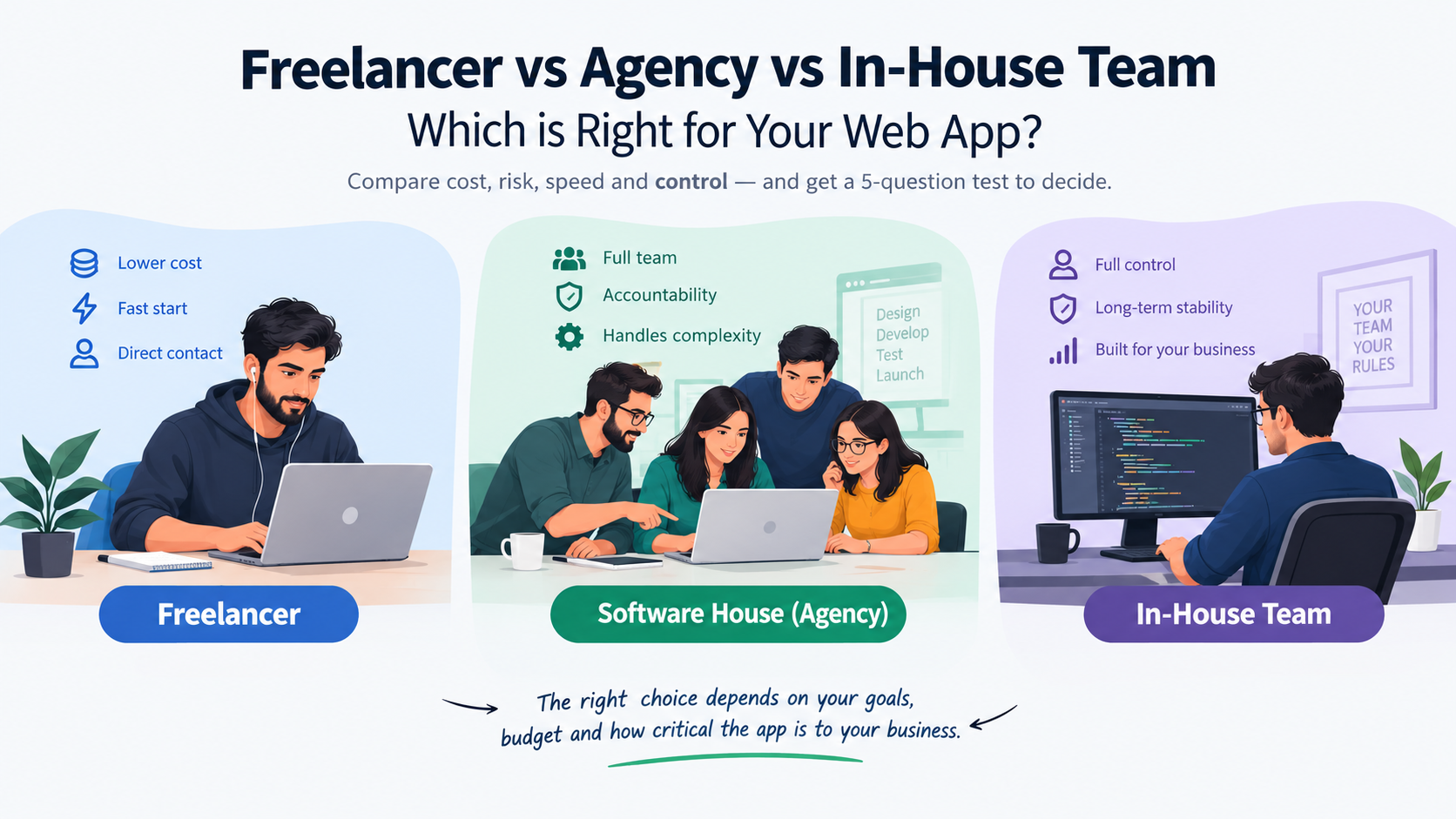
A freelancer is one independent developer paid per project or per hour. A software house (agency) is a company that puts a full team on your project under one contract. An in-house team is developers you employ on monthly salaries. They differ most on who manages the work and what happens when one person leaves.
|
Freelancer |
Software house (agency) |
In-house team |
|
|---|---|---|---|
|
Who you hire |
One developer |
A company with a team |
Your own employees |
|
How you pay |
Fixed price or hourly |
Fixed price, hourly or monthly retainer |
Monthly salaries plus overhead |
|
Time to start |
Days |
1 to 3 weeks |
Weeks to months of hiring |
|
Skills covered |
Usually one or two |
Design, backend, frontend, testing, project management |
Only the people you hire |
|
Who manages the project |
You |
The agency's project manager |
You or your tech lead |
|
If a key person leaves |
Project often stops |
Agency replaces them |
You re-hire and retrain |
|
Code ownership |
Depends on contract |
Depends on contract |
Yours by default |
|
Support after launch |
If they're still available |
Warranty, then a paid support plan |
Built in, while staff stay |
|
Best for |
Small, clear, non-critical builds |
Business-critical apps with several moving parts |
Software that is core to your revenue |
The rest of this guide unpacks each column, starting with the cheapest option on paper.
Hiring a freelance web developer
A freelance web developer works for themselves and usually builds your app alone. Freelancers are the cheapest and fastest option to start, and a good one can build a small web app very well. The risk is structural: one person holds every skill, every deadline and every password.
What freelancers do well
Pakistan has a deep freelance pool. A World Bank study in 2021 found about 42.4% of Pakistani freelancers work in software development (ProPakistani). So finding someone skilled is rarely the hard part.
- Lower cost. No project manager, office or company margin in the price.
- Direct contact. You talk to the person writing the code, not a middleman.
- Fast start. A freelancer can often begin within days.
Where freelancers struggle on web apps
A web app isn't a brochure website. It has logins, user roles, a database, reports, and often integrations like JazzCash, WhatsApp or your accounting system. If you're unsure which one you need, here's the difference between a website and a web app.
That extra scope exposes three gaps:
- One skill set. A strong backend developer may design weak screens, and almost nobody tests their own code well.
- Availability. Many strong Pakistani freelancers earn in dollars on Upwork and Fiverr. When a bigger USD client arrives, a local PKR project can slip down their list.
- No backup. If they fall sick, take a job, or simply stop replying, your project stops with them. Developers call this a "bus factor" of one.
None of this makes freelancers unreliable as people. It's what happens when one person carries a project built for several.
Hire a freelancer when
- The scope is small and written down, for example one internal tool with two or three user roles.
- The app isn't critical to daily revenue, so a delay won't hurt sales.
- You (or someone on your team) can manage the project and test the work.
- Your budget can't cover a team, and you accept the trade-off.
- You need one specific task done on an existing app, like a new report or a payment button.
Hiring a software house (agency)
A software house, which most of the world calls a development agency, assigns a team to your project: usually a project manager, a designer, one or more developers and a tester. You sign one contract and the company stays accountable for delivery, even if individual people change during the project.
What you get
- A full skill set from day one. Design, backend, frontend, testing and deployment are covered without you hiring anyone.
- Someone managing the work. A project manager runs the schedule, so you review progress instead of chasing it.
- Continuity. If a developer leaves the company, the agency replaces them. Your project doesn't restart.
- Support after launch. Most offer a warranty period for bugs, then a monthly support plan.
The downsides
- Higher project fee. You pay for the team, the management and the company's margin.
- Less direct access. You may talk to a project manager more than to the developer.
- Quality varies a lot. Pakistan has thousands of software houses, and a polished website tells you little. A weak agency can be worse than a good freelancer.
That last point matters most. Before you sign with anyone, learn how to vet a software house in Pakistan, including the registration checks and the questions to ask.
Hire a software house when
- The app runs a core part of your business: orders, stock, billing, customers.
- It needs several skills at once, like screen design, integrations and testing.
- Nobody on your side has time to manage developers day to day.
- A delay of a month would cost you real money.
- You want written accountability: one contract, one invoice, one party responsible.
Building an in-house development team
An in-house team means developers on your payroll, working only on your software. It gives you the most control and the deepest product knowledge. It is also the slowest and most expensive option to start, because you pay salaries every month whether there's new work or not.
What an in-house team really costs in Pakistan
Most business owners price in-house as one salary. A working web app team needs at least three people. Using 2026 salary ranges from PNY Trainings' web developer salary breakdown, a small team looks like this:
|
Role |
Why you need it |
Monthly salary (PKR) |
|---|---|---|
|
Senior developer / tech lead (5+ years) |
Architecture, code review, hard problems |
150,000 to 400,000+ |
|
Mid-level developer (2 to 5 years) |
Builds features end to end |
80,000 to 150,000 |
|
Junior developer (0 to 2 years) |
Frontend work, fixes, basic testing |
40,000 to 60,000 |
|
Salaries only |
270,000 to 610,000+ |
That's before overhead. Add these to your estimate:
- Hiring time. Finding a good senior developer can take weeks or months, and nothing ships meanwhile.
- Equipment and tools. Laptops, software licences, hosting and paid tools for each person.
- Office, internet and power backup. Load-shedding doesn't pause deadlines.
- Statutory and HR costs. Contributions such as EOBI, leave, bonuses and annual increments.
- Turnover. Mid-level developers often get their biggest raise by switching jobs, so expect some churn.
These figures are estimates from public salary ranges, not quotes. Your city, stack and seniority will move them.
The one-developer trap
Many growing Pakistani businesses try a shortcut: hire one in-house developer for PKR 80,000 to 150,000 a month and expect a full team.
It rarely works for a real web app. One person can't be the designer, backend developer, tester and server admin at once. Work slows, testing gets skipped, and all the knowledge sits in one head. When that developer leaves, often for a better offer, the business owns code that nobody else understands.
One in-house developer works well for maintaining an app that's already built. It's a risky way to build one from scratch.
Build in-house when
- Software is your product or a core source of revenue, not a support tool.
- You'll have steady work for at least two or three developers for years, not months.
- You can hire and keep a strong senior developer or tech lead.
- You need daily changes and tight control over sensitive data or processes.
Is it cheaper to hire a freelancer or an agency?
A freelancer is almost always cheaper upfront, because you aren't paying for a project manager, tester or company margin. Over the life of a web app, the answer depends on rework, delays and handover. A cheap build that needs rewriting a year later costs more than a sound build done once.
Compare how each option charges, not just the first number:
|
Option |
What you pay for |
Cost keeps running? |
Hidden cost to watch |
|---|---|---|---|
|
Freelancer |
The build, per project or per hour |
Only if you hire them again |
Rework, testing you do yourself, restarting if they leave |
|
Software house |
The build plus management and testing |
Optional support plan after launch |
Paying for change requests outside the scope |
|
In-house team |
Salaries every month |
Yes, indefinitely |
Idle time between projects, hiring and turnover |
For what full projects actually cost in rupees, by app type, see what a web app costs to build in PKR.
A simple rule: if the project ends in a few months, compare the freelancer and agency quotes. If the work never ends, compare an agency retainer against a full in-house monthly bill, not against one salary.
The hybrid model most growing businesses end up with
You don't have to pick one option forever. Many businesses that end up with a healthy web app use different models at different stages:
- A software house builds version one. You get a full team for the risky part: design, architecture, integrations and testing.
- You hire one in-house developer near the end. They join in the last month and learn the codebase while the team is still there.
- The agency hands everything over. Code repository, server access, documentation and a few training sessions go to your developer.
- A small support plan stays in place. The agency covers big features or emergencies; your developer handles daily changes.
- Freelancers fill small gaps. A landing page, a one-off report or a design refresh, managed by your in-house developer.
This is how the one-developer model becomes safe: that person maintains a system a full team built, instead of building it alone. If you want to see the full build process behind version one, read our guide on how to build a web app for your business.
5 questions to decide who should build your web app
Answer these five questions honestly and note the letter for each. The letter that appears most often is your starting point. If the answers split, the hybrid model above is usually the right fit.
|
# |
Question |
F (Freelancer) |
A (Software house) |
I (In-house) |
|---|---|---|---|---|
|
1 |
How big is the app? |
One tool, a few screens |
Several modules, roles and integrations |
A product that keeps growing every month |
|
2 |
What happens if it's late by a month? |
Mild inconvenience |
Lost sales or angry customers |
The business itself stalls |
|
3 |
Who will manage the project day to day? |
You, and you have the time |
Nobody has the time |
A tech lead you already have or will hire |
|
4 |
What does your budget look like? |
One small project budget |
A larger one-time budget |
A monthly budget for salaries, indefinitely |
|
5 |
What happens after launch? |
Small fixes now and then |
Planned updates and support |
Daily changes and new features |
Mostly F: a careful freelancer hire works. Write the scope down and pay by milestones.
Mostly A: shortlist software houses and compare written scopes, not prices.
Mostly I: start hiring your tech lead first, and consider an agency for version one while you build the team.
Protect yourself whichever option you choose
The same four basics protect you from a freelancer who disappears, an agency that stalls, or an employee who resigns:
- Code in your own account. The GitHub or GitLab repository should belong to you from day one.
- Hosting and domain in your name. Add the developer as a user; don't let them own the account.
- Milestone payments. Pay against working features you can test, not dates on a calendar.
- A written scope. One document that says what "done" means. WhatsApp voice notes aren't a scope.
For agency contracts specifically, our software house guide lists the clauses to ask for before you sign.
Hiring from Qatar or the GCC
For a business in Doha, Riyadh or Dubai, building in-house means local salaries plus visa sponsorship and relocation for every developer. That's why many GCC companies outsource version one instead.
A Pakistani team is a practical middle path. Pakistan is two hours ahead of Qatar, so most of the working day overlaps. Agree on the invoice currency (USD, QAR or PKR) and payment route at the start, and insist on video demos rather than written reports. Lumen has offices in Rahim Yar Khan and Doha; see our page on web app development in Qatar.
How Lumen AI fits in (and when we'd tell you not to hire us)
We're a software house, so read this section knowing that. Here's when we'd point you elsewhere:
- Your project is one small tool with a clear scope. A good freelancer will do it for less. Write the scope, pay by milestones, and keep the code in your account.
- Software is your core product and you have years of steady work. Start building your own team. We can build version one and hand it over, but the long-term owner should be yours.
When a full team does make sense, here's how our custom web app development services work:
- A discovery session on your real process, spreadsheets and workarounds included, before we name a price.
- A fixed price and timeline in writing after discovery.
- Working software every week on a link you can open.
- At handover, the repository, documentation and training belong to you. Support afterwards is optional.
A focused internal tool usually reaches its first working release in 4 to 8 weeks. A full platform with several user roles and integrations takes 3 to 6 months. One example: the ERP we built for Lumen Energy Solutions handles about USD 300k of stock a month, and its AI reorder planning helped avoid around USD 20k of excess stock.
Not sure which option fits?
If you already have a brief or a few quotes, send us your project brief. We'll tell you honestly whether a freelancer, an agency or your own team is the better fit, even if the answer isn't us.
Frequently asked questions
Should I hire a freelancer or an agency to build my web app?
Hire a freelancer for a small, clearly scoped web app that isn't business-critical, and an agency when the app needs several skills and can't afford delays. If you can manage the project yourself and the budget is tight, a freelancer is reasonable.
Is it cheaper to hire a freelancer or an agency?
A freelancer is usually cheaper upfront, but the total cost depends on rework, delays and whether the app needs rebuilding later. Compare the full cost over two to three years, including testing and support, not just the first quote.
What happens if my freelancer disappears mid-project?
If a freelancer disappears, you lose time, but milestone payments, a written scope and code in your own repository limit the damage. With those in place, another developer can pick up where they stopped instead of starting over.
Will I own the code if I hire an agency?
You will own the code if your contract includes an IP assignment clause and the repository sits in your own GitHub or GitLab account. Ask for both in writing before the project starts.
When should a business build an in-house development team?
Build an in-house team when software is core to your revenue and you have steady work for at least two or three developers for years. For a one-time project, salaries keep running after the work ends.
Can I use a freelancer and an agency together?
Yes, many businesses use an agency for the core build and freelancers for small, separate tasks like a landing page. Keep one person in charge of both, so work doesn't overlap or break each other's code.