Best ERP Software in Pakistan: How to Compare Odoo, ERPNext, Zoho & Custom ERP
16 min read
On this page
- What Is the Best ERP Software in Pakistan?
- The FBR Digital Invoicing Question Most Comparisons Get Wrong
- What to Actually Ask a Vendor About FBR
- What to Check Before You Compare Platforms
- Odoo vs ERPNext vs Zoho vs Custom ERP
- Is Odoo a Good ERP for Pakistani Businesses?
- Is ERPNext a Good Fit?
- Is Zoho Suitable for Pakistani Businesses?
- When Does Custom ERP Make Sense?
- The Three Level Decision Model
- ERP by Business Type in Pakistan
- Manufacturing
- Wholesale and Distribution
- Retail and E-commerce
- Multi-Branch Businesses
- Professional Services
- What Is the Best ERP for Small Businesses in Pakistan?
- What Drives ERP Cost in Pakistan
- How to Choose ERP Software, Step by Step
- Common ERP Selection Mistakes
- Frequently Asked Questions
- What is the best ERP software in Pakistan?
- Which ERP is best for small businesses in Pakistan?
- Is Odoo good for Pakistani businesses?
- Is ERPNext good for Pakistani businesses?
- Is Zoho an ERP?
- Does ERP software in Pakistan handle FBR digital invoicing?
- How much does ERP software cost in Pakistan?
- Should a Pakistani business choose Odoo or ERPNext?
- Choosing With Requirements First
Every sales tax registered business in Pakistan now has to send its invoices to FBR in real time through a licensed integrator. That one rule has changed how ERP software should be judged here, and most "best ERP in Pakistan" articles have not caught up. They still rank platforms by feature count and then recommend whichever product the publisher happens to sell.
This guide takes a different approach. It gives you a decision framework for choosing between Odoo, ERPNext, Zoho and custom ERP, explains what FBR digital invoicing actually requires from your software, and shows how the right answer changes by industry.
What Is the Best ERP Software in Pakistan?
There is no single best ERP software in Pakistan. The right system depends on your industry, workflows, user count, branches, integration needs, budget and how much customization you can maintain. A garment factory, a Daraz seller and a distribution business will reach three different answers from the same comparison.
That is not a dodge. It is the only honest answer, and you can test it yourself. A manufacturer needs bills of materials, work orders and production costing. An e-commerce seller needs COD reconciliation and marketplace order sync. A professional services firm needs neither, but needs timesheets and project invoicing. No single platform wins all three on merit.
What you can do is narrow the field quickly. The sections below give you the criteria that actually separate these systems in the Pakistani market, starting with the one that matters most in 2026.
The FBR Digital Invoicing Question Most Comparisons Get Wrong
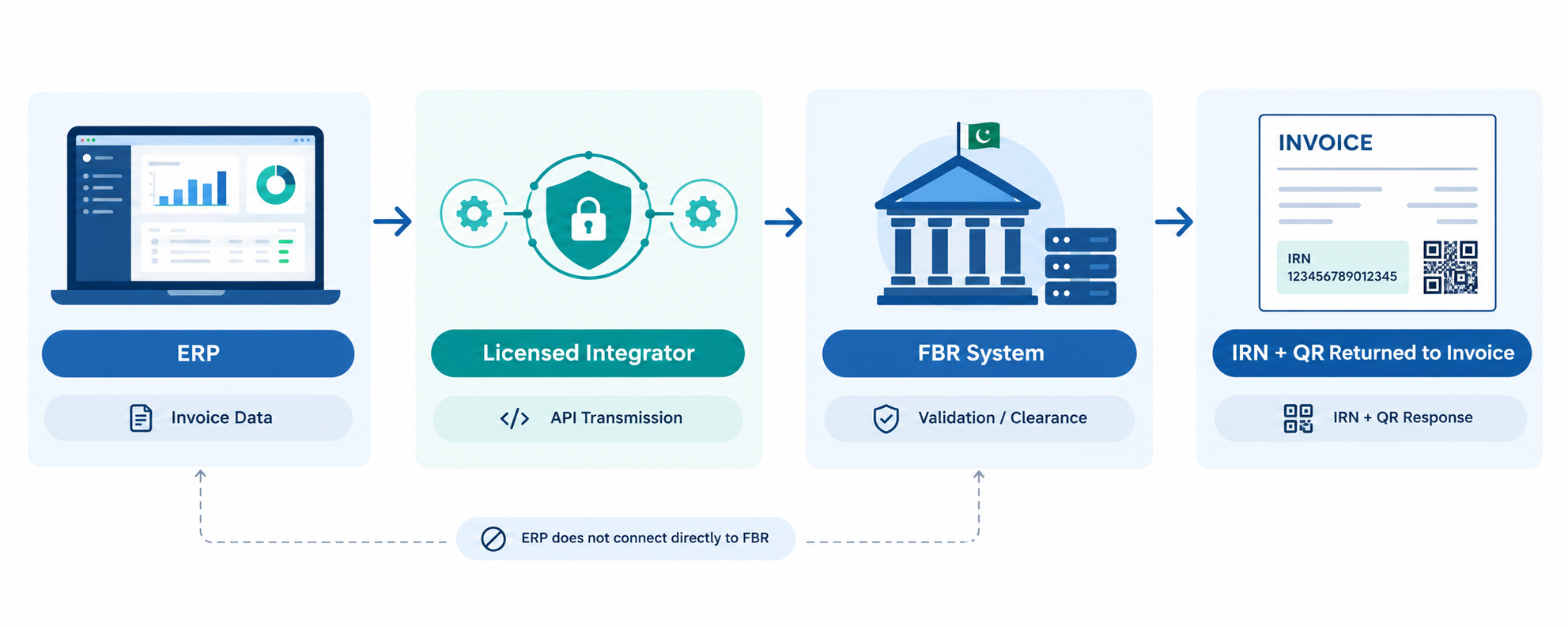
FBR compliance is not a feature you buy inside an ERP. Under the Sales Tax Act 1990, integration with FBR's system has to happen through a licensed integrator holding a valid FBR licence. The ERP is the system that produces the invoice. The integrator is what connects it to FBR.
This distinction matters because almost every vendor markets "FBR compliant ERP" as a product badge, which leads buyers to assume the software itself grants compliance. FBR's own guidance says something different: registered persons may install any electronic invoicing software and integrate it with FBR through a licensed integrator. PRAL offers this integration free of cost, and other licensed integrators operate alongside it. The current list sits on the FBR website and changes as licences are granted, so verify it there rather than trusting a vendor's claim.
Two 2026 updates are worth knowing before you sign anything. A business can now engage more than one licensed integrator rather than depending on a single one. And invoices can be cancelled, deleted or edited within 72 hours of issue for genuine errors, with anything beyond that window needing prior approval from the relevant Commissioner.
What to Actually Ask a Vendor About FBR
Replace "is it FBR compliant?" with these five questions. They produce answers you can verify.
- Which licensed integrator does this connect through? Ask for the name, then check it against FBR's official list yourself.
- Which API version does the integration use? Older versions stop working when FBR updates the specification.
- Does the invoice template carry the invoice reference number and a verifiable QR code? Both have to print on the document.
- How does the system handle the 72-hour correction window? Ask to see a cancellation and an edit performed in a demo.
- What happens when the integration fails mid-day? Queued retries, alerting and a manual fallback matter more than most buyers realise until the first outage.
A system that answers all five clearly is a safer choice than one with twice the module count and vague answers. This is also why FBR compliance should not be the thing that picks your ERP. It is a connection requirement that most serious systems can meet. Let your workflows pick the platform instead.
What to Check Before You Compare Platforms
Requirements come before platform selection, always. Most failed ERP projects in Pakistan trace back to a business comparing demos before it had written down how it actually works.
Document these before you book a single demo:
- Business processes: how an order, a purchase, a dispatch and a payment move today, including the workarounds nobody admits to
- Users and roles: how many people need access, and what each of them should and should not see
- Branches and warehouses: how many locations, and whether stock moves between them
- Inventory complexity: variants, batches, serial numbers, units of measure and conversions
- Accounting requirements: chart of accounts, voucher styles, withholding tax, provincial sales tax differences
- Manufacturing: bills of materials, routings, work in progress and costing method
- Sales channels: counter, website, marketplaces, WhatsApp, field sales
- Integrations: every system the ERP must talk to, named individually
- Reporting: the specific reports management will ask for in month one
- Budget and technical capacity: what you can spend, and who will maintain the system afterwards
Note that provincial tax handling is genuinely different across Punjab, Sindh and KPK, and services registered with a provincial authority sit outside the federal sales tax digital invoicing rules. Confirm your own position with your tax adviser rather than assuming a platform covers it.
Odoo vs ERPNext vs Zoho vs Custom ERP
Here is how the four approaches compare on the factors that decide fit. No ratings or scores, because a star rating tells you nothing about whether a system suits your warehouse.
| Factor | Odoo | ERPNext | Zoho | Custom ERP |
|---|---|---|---|---|
| Standard ERP modules | Broad and modular | Broad, all included | Depends on which products you buy | Designed to requirement |
| Manufacturing | Strong | Strong | Limited | Built to spec |
| Inventory | Strong | Strong | Available | Built to spec |
| CRM | Strong | Available | Strong | Built to spec |
| POS and retail | Strong | Available | Separate product | Built to spec |
| Customization | High, via apps and code | High, fully open source | Moderate | Unlimited |
| Licensing model | Community edition free, Enterprise paid per user and app | Open source, costs shift to hosting and support | Subscription per product or bundle | You own it, you maintain it |
| Pakistan partner availability | Widest of the three | Growing | Thinner for full ERP work | Depends on your development partner |
| Best fit | Broad operations needing several connected modules | Teams wanting open source with no per user licence | CRM led and service businesses already in the Zoho stack | Genuinely unusual workflows |
Is Odoo a Good ERP for Pakistani Businesses?
Odoo suits Pakistani businesses that need several connected modules and want the widest local partner network of the open source options. Its modular structure lets you start with accounting, inventory and sales, then add manufacturing or POS later without replacing the system.
The practical strengths are a broad module range, a polished interface that shortens training, and enough third party apps that uncommon requirements often have an existing answer. Reviewers across comparison sites consistently rate its usability and support ahead of ERPNext.
The trade-offs are real. The Enterprise edition charges per user and per app, so costs climb as headcount grows. The Community edition is genuinely free but leaves out functionality some businesses assume is included, which surprises buyers at the worst moment. Verify which edition a quoted price refers to before you compare it to anything.
Is ERPNext a Good Fit?
ERPNext suits businesses that want full ERP functionality without per user licence fees and have, or can hire, the technical capacity to run it. All modules are included in the open source version, which makes the cost structure fundamentally different from per seat platforms.
Accounting, inventory, manufacturing, purchasing, sales, CRM, HR and projects all come in the box. For a business with a capable technical team or a good local implementation partner, the value is hard to beat.
The honest caveats: the ecosystem of ready made apps is smaller than Odoo's, more requirements end up as custom work, and local implementation support in Pakistan is thinner. If your plan depends on finding a partner who can maintain it for the next five years, confirm that partner exists before you commit.
Is Zoho Suitable for Pakistani Businesses?
Zoho fits CRM led and service businesses better than it fits manufacturers or complex warehouse operations. Its strength is a connected suite of cloud applications, and it makes most sense for companies already using several Zoho products.
Sales teams, consultancies, agencies and service businesses often get more from Zoho than from a full ERP, because the parts they need are CRM, invoicing, expenses and project work rather than production planning. If that describes you, a lighter stack may serve you better than an ERP, and our explainer on the difference between CRM and ERP is worth reading before you spend anything.
Where you will likely need to look elsewhere: multi stage manufacturing, complex multi warehouse operations, deep production costing and heavy ERP level customization. On FBR digital invoicing specifically, Zoho's accounting products have no native Pakistani integration, so that connection has to be solved separately. Confirm the current position before assuming either way.
When Does Custom ERP Make Sense?
Custom ERP makes sense when an important workflow defines how you compete and no established platform supports it without constant workarounds. The word doing the work there is important. Plenty of processes feel unique to the people running them and turn out to be ordinary once mapped.
Genuine cases include specialised pricing logic, layered approval structures that packaged workflow engines cannot express, deep integration with proprietary machinery or legacy systems, and industry processes that general purpose ERPs serve badly.
The cost sits after launch, not during it. Maintenance, security patching, documentation and future development become your responsibility or your partner's. We go through the full trade off in custom ERP vs ready-made ERP, including the middle path most businesses should try first.
The Three Level Decision Model
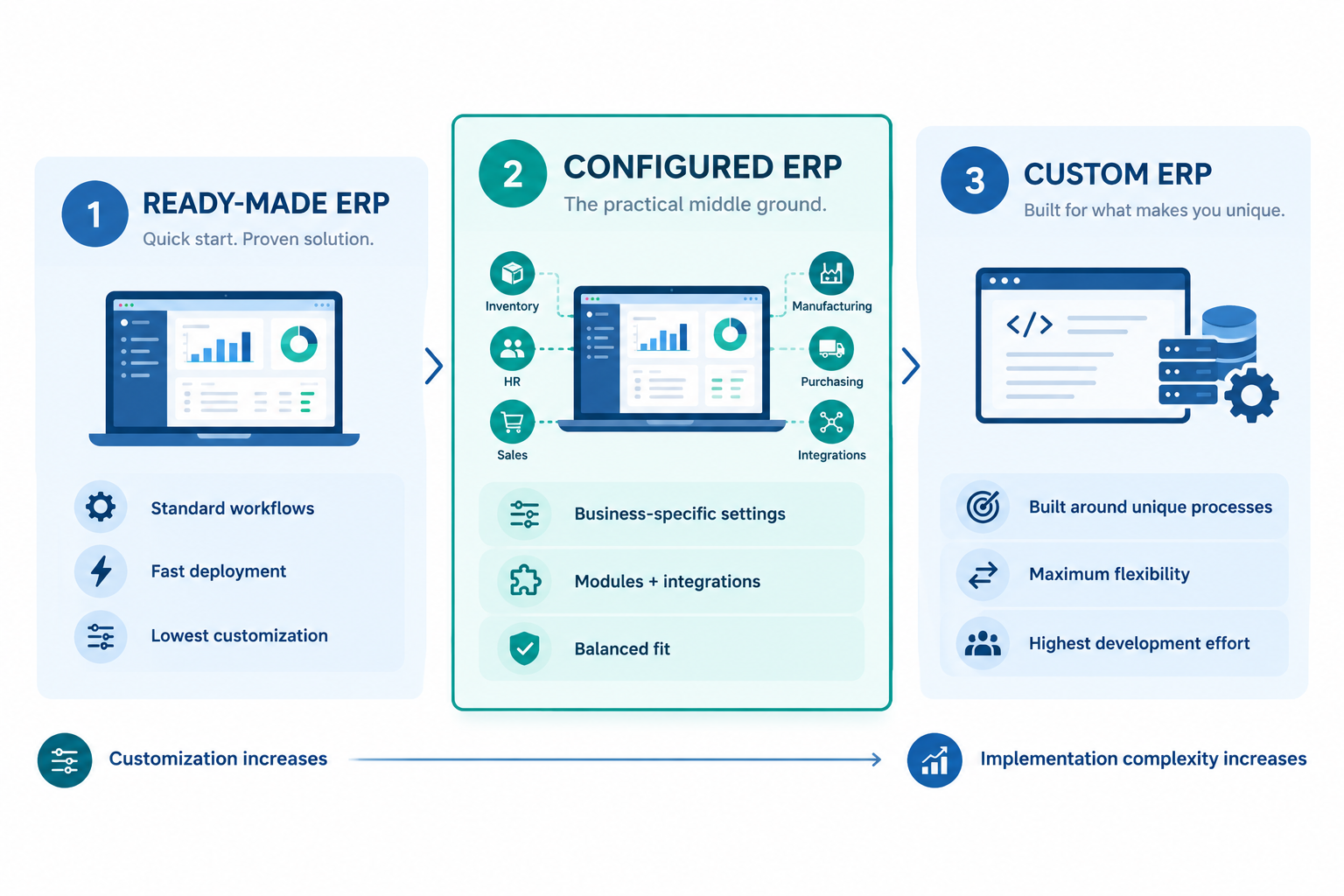
Most buyers frame this as build or buy. A three level model gives better answers, because the middle option covers more real situations than either extreme.
- Ready made ERP. Use a packaged system largely as it ships. Fits conventional processes, limited budgets and situations where speed matters more than a perfect match.
- Configured or customized ERP. Take an established platform and shape it through fields, workflows, reports, permissions, approval rules and integrations. This is where most Pakistani businesses land, and it should be your default assumption until proven otherwise.
- Custom ERP. Build the specific functionality that levels one and two genuinely cannot deliver.
Work through them in order. Rebuilding accounting, stock valuation and reconciliation from scratch means paying to rediscover edge cases that mature platforms solved years ago.
There is a trap at level two worth naming. Heavily customizing a packaged ERP can leave you with the disadvantages of both: the vendor's constraints and upgrade cycle, plus the cost and maintenance burden of custom code. Warning signs are upgrades that repeatedly break your changes and workarounds that outnumber standard features.
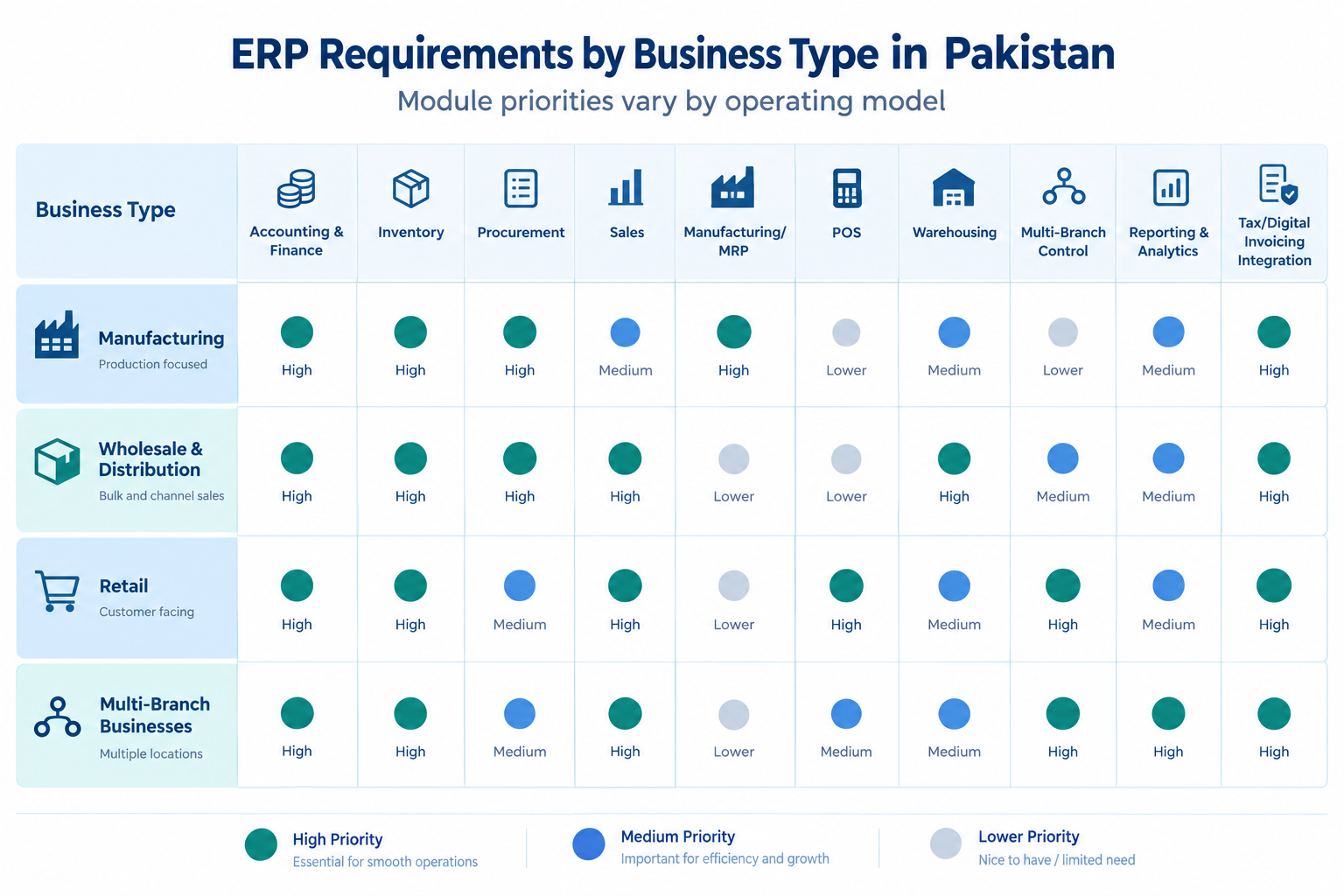
ERP by Business Type in Pakistan
The best ERP for your business depends more on your industry than on any platform ranking. Here is what each type should weight most heavily.
Manufacturing
Prioritise bills of materials, production planning, work orders, work in progress visibility, quality checkpoints and product costing. Textile, food, pharmaceutical and packaging operations each weight these differently, and batch traceability becomes non negotiable where products are regulated. Our guide to ERP for manufacturing businesses covers the costing and WIP requirements in depth.
Wholesale and Distribution
Prioritise multi warehouse inventory, purchasing, customer credit limits, sales order processing, collections and field sales rep management. Credit control usually matters more here than any other module, because the business lives on receivables. See ERP for wholesale and distribution for the detail.
Retail and E-commerce
Prioritise POS, multi store inventory, marketplace and website integration, returns and RTO handling, and COD reconciliation. COD reconciliation deserves specific attention in Pakistan, since the gap between order value and courier payout is where money quietly disappears. Our guide to retail and e-commerce ERP works through that process.
Multi-Branch Businesses
Prioritise centralised customer records, branch level stock and permissions, inter branch transfers, branch profitability reporting and consolidated accounts. Permission design is the part most projects underestimate. ERP for multi-branch businesses covers how to settle those rules before configuration starts.
Professional Services
Prioritise CRM, project management, timesheets, expense tracking, client invoicing and utilisation reporting. Many service firms do not need a full ERP at all, and are better served by a CRM plus accounting software.
What Is the Best ERP for Small Businesses in Pakistan?
For many small businesses in Pakistan, the best answer is not an ERP at all. Accounting software plus a CRM, or a POS plus accounting, covers a surprising amount of ground at a fraction of the cost and effort.
Ask yourself seven questions before shopping for a platform:
- Do we hold and move physical inventory?
- Do we operate from more than one location?
- Do we manufacture or assemble anything?
- Do we sell through more than one channel?
- Do approvals pass through multiple people?
- Is the same transaction being entered into two or more systems?
- Does assembling a basic sales or stock report take more than a few minutes?
Two or fewer yes answers usually means simpler software will serve you better. Five or more means an ERP is worth evaluating properly. If you are somewhere in the middle and growing, our article on ERP software for growing businesses covers how to judge the timing.
One rule holds at every size: do not choose an ERP only for today's requirements. Check whether it supports the next stage of the business, because a migration eighteen months in costs far more than choosing correctly now.
What Drives ERP Cost in Pakistan
Any article quoting a universal ERP price for Pakistan is guessing, because cost is driven by scope rather than by platform. Treat published ranges as a rough starting point for budgeting conversations, not as a quote.
Separate the total into five parts when comparing proposals:
- Software cost: licences or subscriptions, where they apply at all
- Implementation cost: discovery, configuration, testing and rollout
- Customization cost: custom fields, workflows, reports and modules
- Integration cost: connecting FBR integrators, banks, couriers, e-commerce and accounting
- Ongoing support cost: hosting, maintenance, updates and help after go live
The two line items most commonly left out of a low quote are data migration and post go live support. A cheaper headline number that excludes both usually costs more in total. For a full breakdown of the drivers, see our guide to ERP software cost in Pakistan.
How to Choose ERP Software, Step by Step
- Map how your business actually works today, workarounds included.
- List requirements, then split them into must have and nice to have.
- Name every existing system the ERP has to connect to.
- Confirm your FBR digital invoicing position and which licensed integrator route you will use.
- Shortlist three platforms, no more.
- Run demos using your own scenarios, not the vendor's script.
- Test the awkward cases: a partial delivery, a return, a credit note, a cancelled order.
- Check the reports management will actually ask for.
- Review a sample of your real data against the migration plan.
- Calculate total cost of ownership over three years, not month one.
- Assess the implementation partner as carefully as the software.
- Agree the rollout plan and what support looks like after go live.
Step six is where most selections go wrong. A demo built by the vendor will always work. Hand them three of your own transactions and watch what happens. For what follows selection, our walkthrough of how ERP implementation actually runs covers the stages that decide whether the project delivers.
Common ERP Selection Mistakes
- Choosing on price alone. The cheapest quote usually excludes migration, training or integration.
- Choosing on feature count. Two hundred modules you will never open is not an advantage.
- Picking the most popular platform without analysis. Popular elsewhere does not mean suited to your operation.
- Treating FBR compliance as a product badge. Ask about the integrator and the API version instead.
- Ignoring data migration. Duplicate customers and inconsistent item codes carry straight into the new system.
- Ignoring integrations until late. Courier, bank and marketplace requirements surfacing near go live force rushed fixes.
- Over customizing. Every change has to be tested again after each upgrade.
- Skipping real user testing. The people doing the daily work find problems management never sees.
- Forgetting support after go live. The first weeks always surface issues testing missed.
- Treating ERP as an IT project. Finance, operations and sales all have to be in the room.
Frequently Asked Questions
What is the best ERP software in Pakistan?
No single ERP is best for every Pakistani business. The right choice depends on your industry, workflows, user count, branches, integrations, budget and customization needs, so start with requirements rather than platform rankings.
Which ERP is best for small businesses in Pakistan?
Many small businesses in Pakistan do not need a full ERP. Accounting software with a CRM, or a POS with accounting, often covers the need until inventory, multiple locations or multi channel sales add real complexity.
Is Odoo good for Pakistani businesses?
Odoo works well for Pakistani businesses needing several connected modules, and it has the widest local partner network among open source options. Confirm whether a quoted price covers the Community or Enterprise edition before comparing.
Is ERPNext good for Pakistani businesses?
ERPNext suits businesses wanting full ERP functionality without per user licence fees, provided they have technical capacity or a reliable local partner. Its app ecosystem is smaller, so more requirements become custom work.
Is Zoho an ERP?
Zoho is a suite of connected cloud business applications rather than a single ERP. It fits CRM led and service businesses well, but manufacturing and complex warehouse operations usually need a dedicated ERP platform.
Does ERP software in Pakistan handle FBR digital invoicing?
Integration with FBR happens through a licensed integrator, not through the ERP alone. Any electronic invoicing system can be connected this way, so ask which licensed integrator a vendor uses and verify it on FBR's official list.
How much does ERP software cost in Pakistan?
ERP cost in Pakistan depends on users, modules, branches, customization, integrations, migration, training and support. Compare proposals by what each includes rather than by the headline figure, and budget over three years.
Should a Pakistani business choose Odoo or ERPNext?
Choose Odoo for a wider partner network, more ready made apps and faster onboarding. Choose ERPNext to avoid per user licensing and keep full open source control, if you have the technical capacity to support it.
Choosing With Requirements First
The best ERP is the one that fits your workflows, your budget, your industry, your integrations and your growth plans. Not the one with the most modules, and not the one a vendor ranks first on its own blog.
At LumenAI Consultancy we work requirements first: understand how the business actually runs, evaluate established platforms against it, configure where configuration is enough, integrate what already works, and build custom only where there is a genuine gap. Often the answer is that your existing system needs configuration or a connection rather than replacement. You can see that approach in projects like our Lumen Energy ERP build and the Bizro platform.
If you are weighing options now, explore our ERP and CRM solutions for Pakistani businesses, or get in touch to talk through your requirements before you shortlist anything.