POS Software Price in Pakistan: What You'll Really Pay in Year One
13 min read
On this page
- POS software price in Pakistan at a glance
- What you're actually paying for
- The hidden costs that double the bill
- Setup and data entry
- Per-waiter, per-till and kitchen screen add-ons
- Modules sold separately
- Training and staff turnover
- POS hardware cost in Pakistan
- FBR POS integration: what it costs
- First-year cost examples
- Small shop or kiryana
- Restaurant or cafe
- Tier-1 clothing store
- Multi-branch retailer
- Free vs paid POS software
- Cloud POS vs offline POS: which costs less?
- Subscription or custom POS?
- 7 questions to ask before you pay
- Frequently asked questions
- How much does POS software cost in Pakistan?
- Is there free POS software in Pakistan?
- What hardware do I need for a POS system, and what does it cost?
- Is cloud POS or offline POS cheaper?
- How much does FBR POS integration cost?
- Who pays the Re 1 FBR POS fee, the shop or the customer?
- Do I need FBR POS integration if I'm not a Tier-1 retailer?
- Is a one-time custom POS cheaper than a subscription?
- Can POS software also handle inventory and accounts?
- What should I ask a POS vendor before paying?
- The bottom line
A restaurant owner signs up for a POS at a few thousand rupees a month. Then comes the setup fee. Then a charge for each waiter's login. Then the kitchen screen, which turns out to be an add-on. By the end of the first year, the "cheap" system has cost him three or four times what he budgeted.
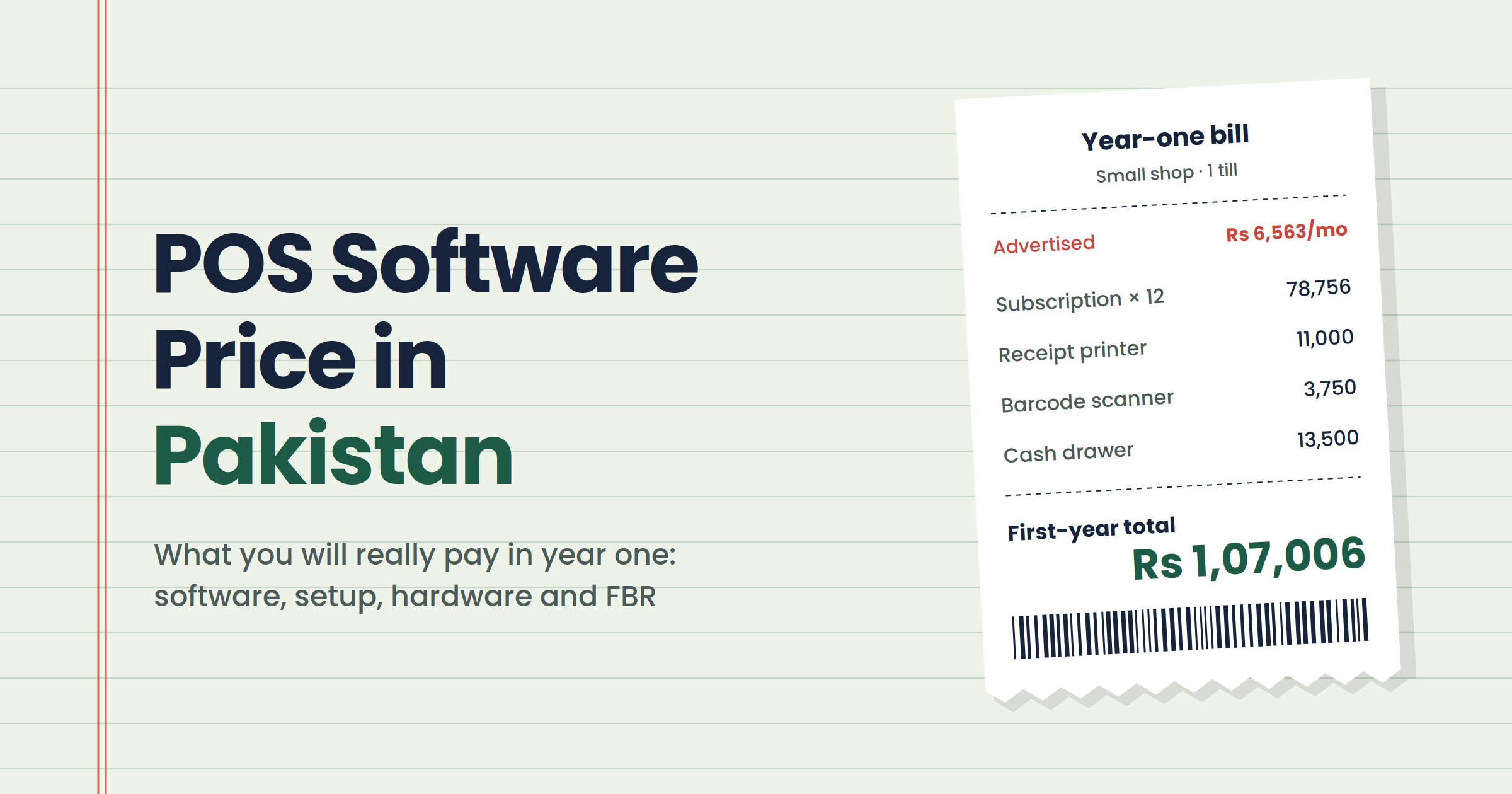
POS software price in Pakistan runs from free to several thousand rupees a month, or a one-time fee if you get one built. But the monthly price is the least useful number to compare. What matters is the first-year bill: software, setup, add-ons, hardware and FBR costs together.
We build POS systems, so we see these quotes all the time. This guide shows you every line that ends up on that bill, with PKR figures, and four worked examples so you can estimate yours before you sign anything.
POS software price in Pakistan at a glance
POS software in Pakistan falls into four price tiers: free apps, low-cost FBR-focused POS, cloud POS subscriptions from local vendors, and one-time custom builds. The tier you need depends on whether you hold stock, run a kitchen, have more than one till and must integrate with FBR.
|
Tier |
Typical price |
Example (source) |
Good for |
|---|---|---|---|
|
Free apps |
PKR 0 for basic use |
Free plans of international POS apps |
One counter, no FBR, simple stock |
|
FBR-focused POS |
Around Rs 1,000/month |
Tier3 FBR POS, free setup on your own hardware (Capterra) |
Tier-1 retailers who mainly need compliant invoices |
|
Local cloud POS subscription |
From about PKR 6,500/month |
HysabOne POS, from PKR 6,563/month billed yearly, no setup fee (HysabOne) |
Shops wanting POS, stock and customer accounts together |
|
Custom-built POS |
PKR 80,000 to 200,000 one-time |
Range published by a Pakistani software house (Softvirtue) |
Businesses with their own workflow or several branches |
Prices as published on 29 October 2026. Check the vendor's page before you budget.
What you're actually paying for
When you pay for POS software, you're paying for the right to use it (a monthly subscription or a one-time licence), plus how many people, tills and branches can use it. Two quotes with the same monthly price can differ by tens of thousands of rupees a year once you count users and devices.
Read every quote for these four things:
- Subscription or licence. A subscription includes updates and support but never ends. A one-time licence or custom build costs more upfront, then usually a smaller yearly maintenance fee.
- Per user, per device or per branch. Some vendors charge for every cashier or waiter login. Others charge per till or per location. Ask which, and count your real headcount, including part-timers.
- Annual vs monthly billing. Many advertised prices assume you pay a full year in advance. The monthly-billing price is often higher.
- What's in the base plan. Inventory, customer credit, kitchen screens, loyalty and reports are often in higher plans. The plan you need is rarely the cheapest one.
The hidden costs that double the bill
The hidden costs of POS software in Pakistan are setup fees, per-user charges, paid add-ons like kitchen screens and inventory, and the time it takes to train staff. Together they often cost more than the subscription itself in the first year, so always ask for a written first-year total.
When we researched the market for a restaurant POS we built, the pattern was clear. A one-branch restaurant with three staff and a kitchen screen commonly ended up paying somewhere between PKR 70,000 and 90,000 in its first year, on a product advertised at a low monthly price.
Setup and data entry
Some vendors charge a setup fee in the tens of thousands. Even when setup is "free", someone has to enter every product, barcode, price and recipe. For a shop with a thousand items, that's days of work. Ask whether the vendor imports from a spreadsheet, and who does it.
Per-waiter, per-till and kitchen screen add-ons
This is where restaurant bills grow fastest. A second till, a waiter's phone or a kitchen display can each carry its own monthly charge. Hire one more cook and your software bill goes up too.
Modules sold separately
Inventory, customer credit (udhaar), loyalty points, multi-branch reports and accounting are often separate modules or higher plans. If you need stock to drop automatically with every sale, price that in from the start.
Training and staff turnover
Cashiers and waiters change often. A system that needs two days of training every time someone new joins costs you in slow service and mistakes. Urdu labels and simple screens are worth real money here.
POS hardware cost in Pakistan
A basic POS hardware setup in Pakistan, meaning a thermal receipt printer, a barcode scanner and a cash drawer, costs roughly PKR 25,000 to 40,000 on top of a PC or tablet you may already own. Restaurants add a kitchen printer or screen; supermarkets add faster scanners and more tills.
|
Item |
Typical PKR price |
What decides the price |
|---|---|---|
|
Thermal receipt printer (80mm) |
Rs 8,000 to 14,500; heavy-duty models around Rs 25,000 |
Print speed, auto-cutter, USB vs network |
|
Thermal printer (58mm, compact) |
About Rs 6,000 |
Smaller receipts; fine for low volume |
|
Barcode scanner (wired, 1D) |
Rs 3,500 to 15,000 |
Brand, laser vs CCD, durability |
|
Barcode scanner (2D, reads QR) |
Rs 7,000 to 28,000 |
Needed for QR codes and damaged labels |
|
Cash drawer (metal) |
About Rs 13,500 |
Size, lock, printer-triggered opening |
|
Till PC or tablet |
Varies widely |
Many small shops start on a PC or Android tablet they already have |
|
UPS for till, printer and router |
Varies by load |
Keeps billing running through short power cuts |
Retail prices listed on W11stop on 29 October 2026. Prices vary by city and supplier.
Two tips save money here. Check which printers and scanners your POS vendor supports before you buy hardware. And don't skip the UPS: a till that dies mid-bill during load-shedding costs you more than the UPS does.
FBR POS integration: what it costs
If you're a Tier-1 retailer, you must integrate your POS with FBR's system so every sale is reported in real time. The FBR charge itself is small: a POS service fee of Re 1 per invoice, which you collect from the customer and deposit with your monthly sales tax return.
That fee is set under SRO 1279(I)/2021, and it doesn't come out of your pocket. Your real cost is the POS itself: it has to support FBR integration, print the FBR invoice number and QR code, and keep working when the connection to FBR drops. Some FBR-focused POS products start around Rs 1,000 a month; full POS systems include it in higher plans.
Not sure if you're Tier-1? The categories and integration steps deserve their own guide, so confirm your status with your tax adviser before you pay for an FBR-ready plan you may not need.
First-year cost examples
Here's what four common businesses can expect to pay in year one, using the published prices above. Your numbers will differ, but the shape of the bill rarely does: hardware is a one-time hit, and the software line grows with every till, user and branch.
|
Business |
Software (year 1) |
Hardware (one-time) |
Rough first-year total |
|---|---|---|---|
|
Small shop, 1 till, no FBR |
PKR 0 (free app) to about 79,000 (local cloud POS) |
About 25,000 |
PKR 25,000 to 105,000 |
|
Restaurant, 1 branch, 3 staff, kitchen screen |
About 70,000 to 90,000 (market pattern we found) |
About 35,000 plus a screen |
PKR 105,000 to 135,000+ |
|
Tier-1 clothing store with FBR |
From about 12,000 (FBR-focused POS) to 79,000+ (POS with stock) |
About 30,000 |
PKR 42,000 to 110,000 |
|
Retailer with 3 branches |
About 236,000 (3 × local cloud POS) |
About 90,000 |
PKR 325,000+ |
Small shop or kiryana
One counter, a barcode scanner and a receipt printer. If you don't need stock control, a free app plus about PKR 25,000 of hardware gets you going. Want stock to drop with every sale and customer credit (udhaar) tracked? A local cloud POS at around PKR 6,563 a month billed yearly is about PKR 79,000 a year before hardware.
Restaurant or cafe
This is where hidden costs bite hardest. Per-waiter logins, a second till and a kitchen screen each add to the bill. In the market we researched for our own restaurant POS, a one-branch restaurant with three staff commonly paid PKR 70,000 to 90,000 on software alone in year one. Add two printers, a cash drawer and a screen for the kitchen.
Tier-1 clothing store
You need FBR integration, and almost certainly stock by size and colour. An FBR-only POS covers compliance cheaply, but if you also want inventory you'll need a full POS plan. The Re 1 per invoice FBR fee is collected from customers, so it doesn't add to your cost.
Multi-branch retailer
Subscriptions usually multiply per branch, so three branches can cost three times as much. At this point, compare a subscription against a one-time build and against an ERP. A system like the one we built for Lumen Energy runs POS, stock and accounts across the business in one place. Our guide to ERP for growing businesses explains when that step makes sense.
Software figures use HysabOne POS (PKR 6,563/month billed yearly) and Tier3 FBR POS (Rs 1,000/month) as published on 29 October 2026; hardware uses the ranges above. Restaurant software figure is from Lumen's own market research.
Free vs paid POS software
Free POS software works for a single counter that doesn't need FBR integration, deep stock control or local support. Once you need any of those, a paid local POS usually pays for itself through fewer stock errors and faster billing.
What you usually give up with free POS apps:
- Offline billing. Many free apps need the internet to take a sale.
- FBR integration. Not offered, so they're out for Tier-1 retailers.
- Pakistani payments and Urdu. JazzCash and Easypaisa recording, Urdu item names and receipts are rare.
- Support. When the printer stops at 9 pm on Chaand Raat, there's no one to call.
Cloud POS vs offline POS: which costs less?
Cloud POS usually costs less upfront because there's no server to buy and updates are included. But in Pakistan, a cloud POS that can't bill without internet is a real business risk. The cheapest option is a cloud POS that works offline first and syncs when the connection returns.
Ask the vendor to switch the router off during the demo. Can you still bill, print and open the drawer? When the internet returns, do bill numbers stay unique across tills? In our own restaurant POS, each device gets its own block of bill numbers for exactly this reason. Any system you buy should handle it somehow.
Subscription or custom POS?
For most single-location shops and restaurants, a subscription POS is the right choice: lower upfront cost, updates included and someone else maintains it. A custom POS makes sense when you run several branches, have a workflow no product fits, or need POS, stock and accounts on one set of records.
A one-time custom POS in Pakistan typically costs PKR 80,000 to 200,000, according to one local software house's published range, plus yearly maintenance. Compare that with your subscription cost over three years, not one. If your POS really needs to share data with purchasing, warehouses and accounts, you're pricing an ERP, so read what a full ERP costs in Pakistan or see how we build ERP and POS software in Pakistan.
7 questions to ask before you pay
Ask every POS vendor these seven questions, and get the answers in writing. They turn a monthly price into a real first-year number.
- Is there a setup fee, and does it include entering my products?
- Do you charge per user, per till, per device or per branch?
- Is the kitchen screen, inventory or customer credit in my plan, or extra?
- Can I bill and print with the internet off?
- Is FBR integration included, and is it in my plan?
- Can I export all my sales, items and customer data if I leave?
- Is this price locked for the year, and what is the monthly-billing price?
Frequently asked questions
How much does POS software cost in Pakistan?
POS software in Pakistan ranges from free apps to local cloud subscriptions from about PKR 6,500 a month billed yearly, and custom systems from PKR 80,000 to 200,000 one-time. Add setup, per-user fees and around PKR 25,000 to 40,000 of hardware to get your real first-year cost.
Is there free POS software in Pakistan?
Yes, several international POS apps have free plans that work for a single counter. They usually lack offline billing, FBR integration, Urdu support and local help, so they suit small shops that aren't Tier-1 retailers and don't need detailed stock control.
What hardware do I need for a POS system, and what does it cost?
Most shops need a PC or tablet, a thermal receipt printer, a barcode scanner and a cash drawer. Printers cost about Rs 8,000 to 14,500, scanners Rs 3,500 to 15,000 and a metal cash drawer about Rs 13,500. Restaurants add a kitchen printer or screen.
Is cloud POS or offline POS cheaper?
Cloud POS is usually cheaper upfront because there's no server and updates are included. Offline POS avoids losing sales when the internet drops. The best value in Pakistan is a cloud POS that keeps billing offline and syncs later, so you get both.
How much does FBR POS integration cost?
FBR charges a POS service fee of Re 1 per invoice, collected from the customer and deposited with the sales tax return. Your cost is the POS that supports integration: FBR-focused products start around Rs 1,000 a month, while full POS systems include it in their plans.
Who pays the Re 1 FBR POS fee, the shop or the customer?
The customer pays it. Tier-1 retailers collect Re 1 per invoice from the buyer and deposit it with their monthly sales tax return under SRO 1279(I)/2021. It appears on the invoice and doesn't come out of the retailer's margin.
Do I need FBR POS integration if I'm not a Tier-1 retailer?
The POS integration requirement applies to Tier-1 retailers. If you're not Tier-1, you don't need an FBR-integrated POS for that rule, though other sales tax obligations may still apply. Confirm your category with your tax adviser before paying for an FBR-ready plan.
Is a one-time custom POS cheaper than a subscription?
Over one year, rarely. Over three to five years, often, especially with several branches or many users. A custom POS costs more upfront, typically PKR 80,000 to 200,000, plus yearly maintenance, but has no per-user or per-branch fees.
Can POS software also handle inventory and accounts?
Many POS systems include basic inventory, and some offer accounting modules in higher plans. If you need stock, purchasing and accounts working together across branches, you're looking at an ERP rather than a POS with add-ons.
What should I ask a POS vendor before paying?
Ask about setup fees, per-user and per-device charges, what's included in your plan, offline billing, FBR integration, data export and whether the price is locked. Get the answers in writing so you can compare the full first-year cost.
The bottom line
POS software price in Pakistan looks simple until the quote arrives. The monthly fee is only one line. Setup, extra users, add-ons and hardware decide what you really pay, and they can triple the number you started with.
Ask for a written first-year total before you sign, and compare vendors on that number alone. Got a quote and not sure it adds up? Send it to us and we'll tell you what's missing, whether or not you end up working with us.